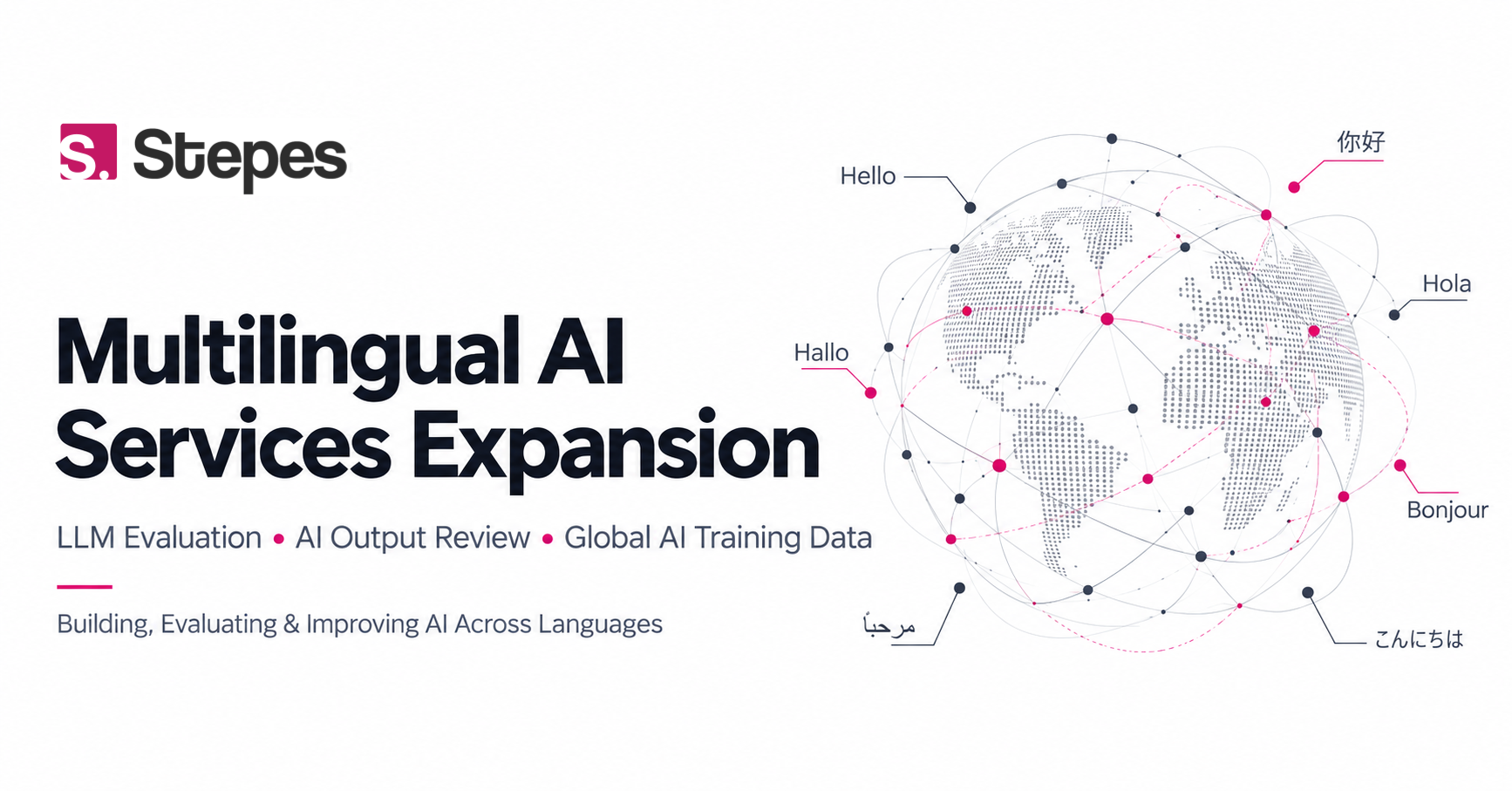
Expanded multilingual AI services help enterprises improve training data, evaluate LLMs, and review AI outputs globally.
BOSTON, MA, UNITED STATES, October 7, 2026 /EINPresswire.com/ — Stepes, a global provider of enterprise translation, localization, and multilingual AI services, today announced an expansion of its multilingual AI capabilities to help organizations build, evaluate, and improve artificial intelligence systems across languages and international markets.
The expanded services bring together multilingual AI data creation, text annotation, voice and conversation data collection, conversational AI training data, large language model (LLM) evaluation, and human review of AI-generated outputs. Together, these capabilities provide enterprises and AI developers with a connected framework for improving AI performance from data preparation and evaluation through real-world deployment and continuous improvement.
As generative AI, enterprise copilots, AI agents, chatbots, retrieval-augmented generation (RAG) systems, and voice assistants reach users around the world, multilingual performance has become an increasingly important dimension of AI quality.
A system that performs well in one language may not deliver the same accuracy, relevance, safety, cultural appropriateness, terminology, or user experience in another. For organizations using AI across global markets, multilingual content generation alone is not enough. They need high-quality native-language data, structured human evaluation, and ongoing validation to ensure their AI systems perform effectively in each market.
Stepes addresses these requirements by combining native-language expertise, structured evaluation methodologies, multilingual data services, and scalable technology workflows across more than 100 languages.
Building Better Multilingual AI Data
High-performing global AI begins with high-quality language data. Stepes helps organizations create, collect, annotate, and validate multilingual datasets for model training, fine-tuning, testing, evaluation, and continuous improvement.
Through its Multilingual AI Data Services, Stepes supports native-language text and prompt creation, multilingual text annotation, speech and conversation collection, and structured conversational datasets tailored to specific AI applications and target markets.
Stepes’ Multilingual Text Annotation Services support use cases such as natural language processing, classification, search, content moderation, conversational AI, and LLM development. Projects may include intent and entity annotation, semantic labeling, sentiment classification, safety categorization, and customer-defined taxonomies.
For speech and voice AI, Stepes supports multilingual data collection across accents, dialects, speaker profiles, devices, and real-world scenarios, including scripted and spontaneous speech, multi-speaker conversations, transcription, segmentation, and associated metadata.
Stepes also develops conversational AI training data, including native-language intents, utterances, prompt-response pairs, multi-turn dialogues, edge cases, and realistic conversation scenarios for chatbots, virtual assistants, enterprise agents, and customer service automation.
Together, these services help AI teams build datasets that better reflect how people communicate across languages, regions, and cultures.
Evaluating AI Performance Across Languages
Creating multilingual AI is only part of the challenge. Organizations also need reliable ways to determine whether their models and AI applications perform consistently across international markets.
Stepes’ Multilingual LLM Evaluation Services provide structured human evaluation for measuring AI behavior across languages, locales, domains, tasks, and model versions.
Native-language evaluators and subject-matter specialists can assess AI responses using criteria such as factual accuracy, relevance, fluency, completeness, instruction adherence, terminology, cultural appropriateness, safety, and overall usefulness.
Evaluation programs can include rubric-based scoring, pairwise preference comparisons, hallucination and factuality review, error classification, and cross-language benchmarking. Stepes also supports evaluation of practical AI use cases such as multi-turn conversations, summarization, domain-specific content, and RAG responses where grounding and factual alignment must be assessed together.
This enables organizations to move beyond asking whether an AI system works in general and determine whether it works reliably in the specific languages and markets where it will be deployed.
Improving AI Outputs for Real-World Global Use
Model evaluation measures how an AI system performs. Multilingual AI Output Review Services address the next challenge: ensuring that the content AI systems generate for actual users is accurate, useful, and appropriate for each market.
Stepes provides human review and quality assurance for outputs generated by LLMs, enterprise copilots, chatbots, RAG applications, voice assistants, customer support systems, and other AI-enabled products.
Depending on the application, reviewers can evaluate, score, classify, correct, approve, or refine AI-generated content based on linguistic quality, factual accuracy, terminology, clarity, tone, cultural fit, consistency, and real-world usability.
This becomes increasingly important as enterprises move AI from experimentation into production. A model may perform well against a benchmark while individual responses still require validation in customer-facing, specialized, regulated, or high-impact environments.
Structured AI output review can provide a practical human-in-the-loop quality layer while generating insights that help improve prompts, datasets, evaluation criteria, and future model performance.
Human Expertise for Global AI Quality
Although AI technology continues to advance rapidly, evaluating language remains closely connected to human communication and context.
A response can be grammatically correct yet culturally inappropriate. Content can sound fluent while containing a factual error. Terminology that works in one market may be unfamiliar or misleading in another. A technically correct answer may still fail to reflect local user intent, tone, or expectations.
Stepes brings professional native linguists, trained evaluators, annotators, and subject-matter specialists into multilingual AI workflows where human judgment adds the greatest value. Structured guidelines, reviewer calibration, quality controls, and cross-language workflow management help organizations produce consistent and actionable evaluation results at enterprise scale.
“AI does not become truly global simply because a model can generate content in many languages. It has to be trained, evaluated, and continuously validated in the languages, cultures, and real-world environments where people actually use it,” said Alex Matsikas, Localization Program Manager at Stepes. “Our expanded multilingual AI services bring together native-language data, human evaluation, and scalable technology workflows to help organizations build AI experiences that perform more reliably around the world.”
Supporting Enterprise AI Across Industries
The expanded services are designed for technology companies, AI developers, and global enterprises building or deploying AI across international markets.
Applications can include multilingual chatbots, virtual assistants, enterprise copilots, AI agents, international search, RAG systems, customer support automation, voice AI, knowledge platforms, and domain-specific language models.
Stepes’ industry expertise also supports multilingual AI initiatives in life sciences and healthcare, financial services, legal and compliance, technology and software, manufacturing and engineering, retail and ecommerce, and other sectors where contextual accuracy, terminology, and subject-matter expertise are especially important.
Programs can be configured by language, locale, data type, domain, evaluation methodology, reviewer profile, quality requirements, and deployment stage, enabling organizations to use individual services or coordinate multiple multilingual AI workflows around broader business objectives.
Extending Stepes’ AI-Enabled Language Technology Strategy
The multilingual AI services expansion builds on Stepes’ broader strategy of combining language technology with professional human expertise to help enterprises communicate and operate globally.
For traditional multilingual content, Stepes uses AI-powered translation technology, translation memory, terminology management, workflow automation, professional linguistic review, and quality assurance based on the purpose and risk profile of the content.
For emerging AI applications, that same global language infrastructure now extends further upstream and downstream, from multilingual data creation and annotation to model evaluation and production-output review.
The result is a connected language ecosystem that can support the AI lifecycle from data creation and preparation through evaluation, deployment, and continuous improvement.
About Stepes
Stepes is a global provider of enterprise translation, localization, and multilingual AI services. The company combines AI-powered technology, professional linguistic expertise, terminology management, workflow automation, and quality assurance to help organizations communicate, operate, and deploy technology across international markets.
In addition to professional translation and localization, Stepes provides multilingual AI data creation, text annotation, voice and conversation data collection, conversational AI training data, LLM evaluation, and AI output review across more than 100 languages.
Stepes
Legal Disclaimer:
EIN Presswire provides this news content “as is” without warranty of any kind. We do not accept any responsibility or liability
for the accuracy, content, images, videos, licenses, completeness, legality, or reliability of the information contained in this
article. If you have any complaints or copyright issues related to this article, kindly contact the author above.

Media gallery