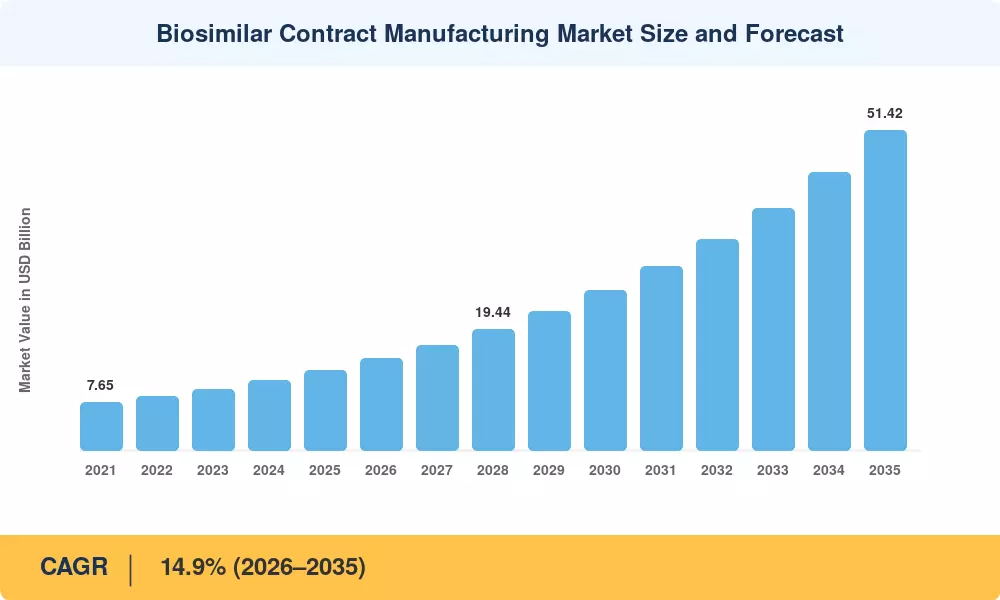
Biosimilar Contract Manufacturing Market to Surge from USD 12.82 Bn in 2025 to USD 51.42 Bin by 2035- Biologic Patent Cliff, Payer Cost-Containment Mandates
NY, CA, UNITED STATES, September 23, 2026 /EINPresswire.com/ — As per Market Research Future, the global Biosimilar Contract Manufacturing Market size is projected to reach USD 51.42 Billion by 2035 from USD 12.82 Billion in 2025, at a CAGR of 14.9% during the forecast period 2026–2035. The market opens the forecast window at USD 14.73 Billion in 2026.
The 14.9% CAGR—anchored by structural shifts in biologic manufacturing outsourcing—is propelled by three converging forces: the biologic patent cliff, with roughly USD 180 billion in annual biologic sales losing exclusivity between 2026 and 2032, and most sponsors chasing those molecules do not own commercial-scale bioreactor capacity; payer economics and cost-containment mandates, including the US Inflation Reduction Act’s negotiation list and Europe’s tender-driven procurement, which have compressed reference-product pricing to the point where in-house plants rarely clear their cost of capital; and advancements in manufacturing technologies, particularly single-use intensified perfusion lines and high-density fed-batch processes that have lifted typical monoclonal antibody titres from 2–3 g/L to 6–9 g/L, reducing capital intensity per gram by almost 40%.
Global pharmaceutical companies and contract manufacturing organizations are amplifying this momentum. Samsung Biologics completed Plant 5 at Songdo in April 2025, adding 180,000 litres and lifting total capacity above 780,000 litres—the largest single site globally. Lonza closed the acquisition of the Vacaville, California biologics site from Roche for approximately USD 1.2 billion, adding 330,000 litres of US mammalian capacity.
Fujifilm Diosynth opened its Holly Springs, North Carolina facility following a USD 3.2 billion commitment, with eight 20,000-litre bioreactors. Samsung Biologics, Lonza and WuXi Biologics have together committed more than USD 12 billion to new capacity since 2023, much of it intended for biosimilar medication manufacture rather than innovative biologics. These forces are creating the manufacturing infrastructure and sponsor demand on which the Biosimilar Contract Manufacturing Market depends.
Request A Free Sample:
https://www.marketresearchfuture.com/sample_request/11903
Key Market Trends & Growth Drivers
The Patent Cliff Is the Demand Engine
The market is witnessing an unprecedented wave of biologic patent expiries. Roughly USD 180 billion in annual biologic sales lose exclusivity between 2026 and 2032, and most sponsors chasing those molecules do not own commercial-scale bioreactor capacity. This trend indicates a structural shift in pharmaceutical manufacturing strategy, with biosimilar developers increasingly outsourcing to specialist contract manufacturers. Samsung Biologics continues expanding large-scale mammalian capacity through sustained mega-plant investment at Songdo.
Payer Economics Force Cost Discipline
Medicare’s negotiated maximum fair prices took effect in January 2026 for the first ten selected drugs, with seven biologics in the second tranche. European tender systems already clear biosimilar insulins and anti-TNFs at 65–80% discounts to originator list price. At those realisations, a sponsor needs cost of goods below USD 40 per gram of drug substance—achievable at a specialist contract site running 6 g/L titres, rarely achievable in a captive plant at 40% utilisation. Procurement teams have responded by shifting roughly 71% of new biosimilar programs to external manufacture. Lonza continues strengthening its broadest modality coverage globally through strategic acquisitions and capacity expansion.
Process Intensification Rewrites Unit Economics
Innovations in manufacturing processes are becoming a hallmark of the industry. Perfusion and high-density fed-batch processes have lifted typical monoclonal antibody titres from 2–3 g/L to 6–9 g/L over eight years. Lonza’s Visp facility and Samsung Biologics Plant 5 both deploy intensified trains that deliver the output of a legacy 15,000-litre stainless line from a 4,000-litre single-use suite. Capital per annual kilogram falls by 38–45%, and changeover between programs drops from 12 weeks to under four. For contract manufacturers, that means more programs per suite per year—the single most powerful margin lever available. Mammalian expression systems commanded approximately 74.5% of the Biosimilar Contract Manufacturing Market in 2025, reflecting antibody dominance in the off-patent pipeline.
Regulatory Convergence Shortens Development Timelines
The incorporation of regulatory streamlining into the industry is gaining traction. EMA’s 2024 reflection paper on tailored clinical development signalled that comparative efficacy trials may be waived where analytical and PK similarity is robust. FDA followed with draft guidance in 2025 easing switching-study requirements for interchangeability. Removing a Phase III comparative trial saves a sponsor USD 60–100 million and 24 months—but raises the analytical burden, which flows straight to contract laboratories. The market is projected to expand as sponsors increasingly outsource analytical and comparability studies to specialist CDMOs.
Ask for Customization:
https://www.marketresearchfuture.com/ask_for_customize/11903
Market Segment Insights
BY PRODUCTION TECHNOLOGY
Mammalian: Largest segment with 74.5% share in 2025, driven by antibody and fusion protein dominance in the off-patent pipeline. Samsung Biologics continues expanding mammalian capacity through sustained mega-plant investment.
Microbial: Fastest-growing platform on a volume basis, concentrated in insulins, filgrastim and teriparatide programs. Microbial systems retain a durable niche as E. coli produces insulin glargine and filgrastim at a fraction of mammalian cost.
BY PRODUCT
Recombinant Glycosylated Proteins: Largest segment valued at USD 6.34 Billion in 2025, driven by oncology antibody expiries. Comparability demands on glycan profiles make them the most analytically intensive—and therefore highest-priced—programs to manufacture.
Recombinant Non-glycosylated Proteins: Significant share at 38.6% in 2025, due to insulin and growth factor volume in established therapeutic areas.
Recombinant Peptides: Fastest-growing product segment at 15.8% CAGR, as semaglutide-class molecules approach expiry in select jurisdictions.
BY APPLICATION
Oncology: Largest segment with 42.8% share in 2025, led by trastuzumab, bevacizumab and rituximab follow-ons. Checkpoint inhibitors entering the follow-on pipeline will reinforce this lead.
Chronic & Autoimmune Diseases: Significant segment generating USD 3.09 Billion, driven by anti-TNF and IL-inhibitor expiries. Patients remain on therapy for years, making demand forecasting more reliable.
Blood Disorders: Smaller but steady share at 12.3%, reflecting epoetin and filgrastim demand in haematology.
Infectious Diseases: Fastest-growing indication at 16.4% CAGR, as antiviral antibody development accelerates.
Growth Hormone Deficiency: Niche segment valued at USD 0.71 Billion, concentrated in somatropin volume in emerging markets.
BY SERVICE TYPE
Upstream Processing: Dominant service with 35.2% share in 2025, consuming the most capital equipment and calendar time. Cell-line and bioreactor capacity remain the core outsourced value proposition.
Downstream Processing: Significant segment valued at USD 3.72 Billion, driven by purification and chromatography scale requirements.
Fill & Finish Operations: Fastest-growing service at 16.1% CAGR, as prefilled syringe and autoinjector demand replaces vials across the biosimilar portfolio.
Analytical & QC Studies: Critical segment at 12.4% share, reflecting comparability and stability testing burdens that intensify as regulators waive clinical trials.
Packaging & Labelling: Supporting segment valued at USD 0.56 Billion, driven by multi-market serialisation requirements.
Read Detailed Insights:
https://www.marketresearchfuture.com/reports/biosimilar-contract-manufacturing-market-11903
Regional Outlook
North America — Market Leader in Innovation
North America leads with 41.5% of global revenue in 2025, generating around USD 5.32 Billion. The region’s growth is driven by FDA interchangeability channels, a solid contract-development basis, and CHIPS-style onshoring logic. The United States anchors the market through sheer approval volume—FDA has licensed more than 65 biosimilars, with 2025 filings running at record pace. The 2024 BIOSECURE legislative push made several large sponsors dual-source away from Chinese sites, redirecting an estimated USD 1.4 billion in annual contract spend toward US and European capacity. The competitive landscape is characterized by continuous capacity investment and strategic acquisitions among leading CDMOs.
Europe — Second Largest Market
Europe was valued at approximately USD 3.46 billion in 2025, representing the second-largest regional market with a 27.0% share. The region benefits from tender-driven volume, EMA’s 2024 tailored-comparability guidance compressing development schedules, and dense CDMO clusters. Danish and Norwegian tenders achieve biosimilar penetration above 90% within twelve months of launch, giving sponsors predictable volume that translates directly into firm capacity reservations. France 2030 has allocated roughly EUR 800 million to bioproduction infrastructure, explicitly targeting the reshoring of essential medicine manufacture. Leading countries include Germany, the UK, and France, where major CDMOs such as Lonza and Boehringer Ingelheim are heavily invested.
Asia-Pacific — Rapidly Growing Market Segment
The Asia-Pacific region accounts for approximately 22.8% of the global share. The growth is driven by greenfield capacity build-outs, cost leadership, and rising biosimilar demand. South Korea’s Songdo district alone holds over 900,000 litres of installed mammalian capacity, and Samsung Biologics’ Plant 5 added 180,000 litres in 2025. India’s Production Linked Incentive scheme for pharmaceuticals has disbursed incentives against roughly USD 2.1 billion of committed biologics investment. The region advances at a 17.6% CAGR, the fastest of any region. The competitive landscape is evolving with companies like WuXi Biologics and Celltrion leading the charge.
South America — Emerging Procurement Powerhouse
South America holds around 5.2% of the global share, anchored by Brazilian public procurement. Brazil’s Productive Development Partnership model trades guaranteed Ministry of Health purchasing for local technology transfer, and biosimilar trastuzumab and rituximab have both moved through it. Contract manufacturers willing to accept a decade-long local partner obligation gain access to procurement volumes that bypass conventional tender competition entirely. Argentina serves as an ANMAT regional export hub.
Middle East and Africa — Untapped Potential
The MEA region holds around 3.5% of the global share, driven by localisation mandates and access programs. Saudi Arabia’s National Unified Procurement Company now applies a local-content preference of up to 20% in bid scoring, which has drawn several international manufacturers into joint ventures near King Abdullah Economic City. South Africa leads with SAHPRA capacity strengthening, while Egypt benefits from universal health insurance rollout. Africa’s broader picture depends on the African Medicines Agency reaching operational maturity.
Competitive Landscape and Recent Developments
The Biosimilar Contract Manufacturing Market is characterized by intense competition and rapid growth, driven by the biologic patent cliff and increasing outsourcing by mid-cap sponsors worldwide. The global industry appears moderately concentrated, with the top five suppliers accounting for roughly 52–58% of global outsourced revenue and an estimated HHI of around 1,450.
KEY COMPANIES AND RECENT MILESTONES
Samsung Biologics (KR): Estimated revenue share of 17–21%. Completed Plant 5 at Songdo in April 2025, adding 180,000 litres and lifting total capacity above 780,000 litres—the largest single site globally. Continues expanding large-scale mammalian, fill-finish, and cell-line development capabilities.
Lonza Group (CH) (January 2025): Estimated revenue share of 12–15%. Closed acquisition of the Vacaville, California biologics site from Roche for approximately USD 1.2 billion, adding 330,000 litres of US mammalian capacity. Offers the broadest modality coverage globally, including mammalian, microbial, bioconjugation, and drug product.
Boehringer Ingelheim BioXcellence (DE) (July 2024): Estimated revenue share of 7–10%. Committed EUR 500 million to expand its Biberach biologics site, targeting intensified perfusion trains for follow-on antibodies. Deep biosimilar regulatory heritage across mammalian and microbial platforms.
WuXi Biologics (CN): Estimated revenue share of 6–9%. Offers integrated discovery-to-commercial services with perfusion expertise. Cost-competitive positioning while navigating geopolitical dynamics. Part of the USD 12 billion collective capacity commitment since 2023.
Fujifilm Diosynth Biotechnologies (JP/US) (October 2024): Estimated revenue share of 5–8%. Opened its Holly Springs, North Carolina facility following a USD 3.2 billion commitment, with eight 20,000-litre bioreactors. Aggressive multi-site expansion across mammalian, microbial, and continuous processing.
Celltrion (KR) (September 2024): Estimated revenue share of 4–6%. Announced a USD 1.9 billion multi-year capital plan covering a fourth plant and expanded fill-finish capability. Vertically integrated sponsor-manufacturer with deep antibody manufacture expertise.
Other Key Players: Rentschler Biopharma (DE), AGC Biologics (JP/US), KBI Biopharma (US), Chime Biologics (CN), ProBioGen (DE), Binex Co., Ltd. (KR).
Future Outlook: 2026–2035
The Biosimilar Contract Manufacturing Market is projected to reach USD 51.42 billion by 2035, growing at a CAGR of 14.9%, driven by the biologic patent cliff, payer cost-containment mandates, and process intensification revolution.
New opportunities lie in:
– Expansion into emerging markets with tailored capacity partnerships
– Development of subcutaneous and high-concentration formulation expertise
– Investment in analytics-as-a-service and data monetisation platforms
– End-to-end integrated programs from cell-line development through commercial fill-finish
– Digital twins and autonomous bioprocessing for tighter glycan consistency
– Sustainability as a contract criterion, with carbon intensity per gram becoming competitive variable
By 2035, the Biosimilar Contract Manufacturing Market is expected to achieve substantial growth and innovation.
More Related Research Insights:
https://www.marketresearchfuture.com/reports/biologics-market-1339
https://www.marketresearchfuture.com/reports/immunoassay-market-5841
https://www.marketresearchfuture.com/reports/healthcare-bpo-market-1335
https://www.marketresearchfuture.com/reports/small-molecule-api-market-763
https://www.marketresearchfuture.com/reports/healthcare-rfid-market-7580
https://www.marketresearchfuture.com/reports/dental-implants-market-2753
https://www.marketresearchfuture.com/reports/patient-engagement-solutions-market-8373
https://www.marketresearchfuture.com/reports/dna-sequencing-market-5774
https://www.marketresearchfuture.com/reports/c-reactive-protein-testing-market-12157
https://www.marketresearchfuture.com/reports/disposable-endoscope-market-11765
https://www.marketresearchfuture.com/reports/non-alcoholic-fatty-liver-disease-market-42175
Market Research Future
Market Research Future
+1 855-661-4441
email us here
Legal Disclaimer:
EIN Presswire provides this news content “as is” without warranty of any kind. We do not accept any responsibility or liability
for the accuracy, content, images, videos, licenses, completeness, legality, or reliability of the information contained in this
article. If you have any complaints or copyright issues related to this article, kindly contact the author above.

Media gallery