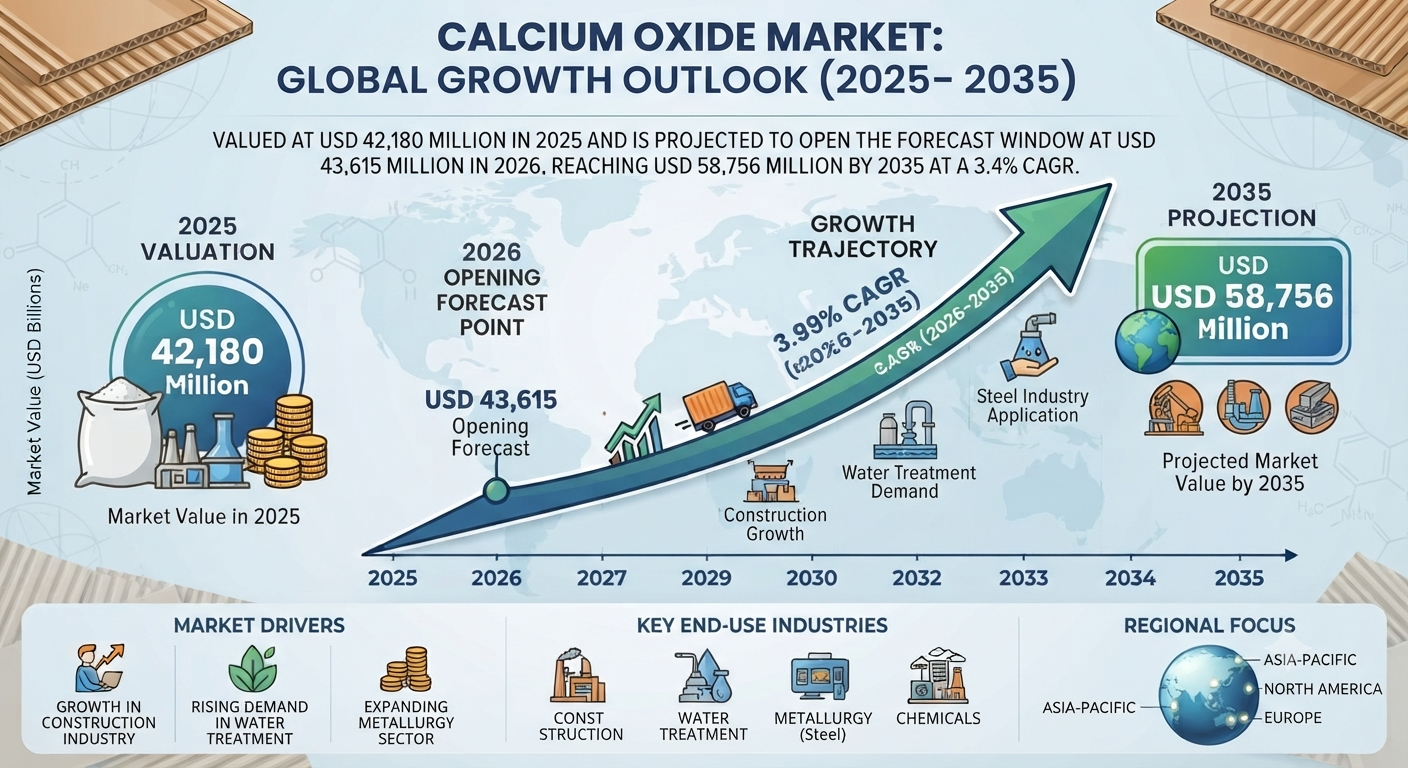
NEW YORK, NY, UNITED STATES, September 22, 2026 /EINPresswire.com/ — The global calcium oxide market, commonly known as the quicklime market, is entering a period of steady expansion as demand grows across metallurgy, construction, environmental management, chemicals, and water treatment. According to the latest Market Research Future analysis, the market was valued at USD 42,180 Million in 2025 and is projected to reach USD 58,756 Million by 2035, representing a 3.4% CAGR from 2026 to 2035. The market is projected to reach approximately USD 43.62 billion in 2026.
Calcium oxide is a versatile industrial material produced primarily through the calcination of limestone. Its chemical reactivity and ability to regulate pH, remove impurities, and support high-temperature industrial processes make it an important raw material across several industries.
Steel Industry Remains a Major Demand Center
The metallurgical industry represents the largest end-user segment of the calcium oxide market, accounting for 39.6% of market share in 2025, according to Market Research Future. Calcium oxide is widely used in steelmaking for slag conditioning and refining, where it helps control slag chemistry and remove impurities.
The continued expansion of electric arc furnace capacity is also influencing product requirements. While electric steelmaking can reduce reagent intensity per ton compared with some traditional processes, it places greater emphasis on consistent calcium oxide chemistry and reactivity.
This is creating opportunities for producers capable of supplying reliable grades tailored to increasingly specific metallurgical requirements.
Get Sample @ https://www.marketresearchfuture.com/sample_request/19237
Construction Continues to Support Market Growth
Construction remains another important source of calcium oxide demand. Quicklime is used in cement production, soil stabilization, and other construction-related applications.
Global urbanization and infrastructure development are sustaining demand for cement and related materials. At the same time, efforts to reduce the carbon intensity of construction materials are encouraging manufacturers to investigate alternative binders and lower-carbon cement technologies.
These developments could increase demand for higher-purity calcium oxide grades in specialized construction and binder applications.
Environmental Applications Gain Momentum
Environmental regulations are becoming an increasingly important driver for calcium oxide consumption. The material is used in flue-gas desulfurization, where it helps remove sulfur dioxide from industrial emissions.
Market Research Future identifies flue-gas desulfurization as representing 24.8% of calcium oxide applications, supported by regulatory-driven retrofit activity.
Water and wastewater treatment is another growing application. Calcium oxide can be used for pH adjustment, water softening, phosphorus removal, and sludge stabilization. The report projects the water and wastewater treatment application to grow at a 4.1% CAGR through 2035.
As governments invest in municipal water infrastructure and industries face tighter environmental standards, these applications could provide a stable source of demand.
Agriculture Creates Additional Opportunities
Calcium oxide is also used as a soil amendment, particularly for correcting soil acidity. Improving soil pH can help optimize nutrient availability and support agricultural productivity.
The agriculture opportunity is particularly relevant in regions with large areas of acidic soils. Growing efforts to improve agricultural yields and soil health could therefore support additional calcium oxide consumption alongside its established industrial applications.
High-Purity Calcium Oxide Gains Importance
While conventional high-calcium grades continue to dominate the market, specialty and high-purity calcium oxide products are gaining attention.
Market Research Future estimates that high-calcium grades represented 71.4% of the market in 2025, while high-purity specialty calcium oxide is projected to be the fastest-growing product grade, with a 5.1% CAGR through 2035.
Higher-purity materials can serve applications requiring tighter chemical specifications, including advanced binders, chemical processing, and specialized industrial applications. This shift could encourage producers to focus not only on production volume but also on product consistency, purity, and reactivity.
Asia-Pacific Leads the Global Market
Asia-Pacific currently represents the largest regional market, accounting for approximately 45.9% of global calcium oxide demand. China and India are important contributors, supported by large steelmaking industries, construction activity, manufacturing, and infrastructure investment.
The region’s industrialization and urbanization are expected to continue supporting demand across metallurgy, cement, chemicals, and environmental applications.
The Middle East and Africa region is identified as the fastest-growing regional market, with a projected 4.25% CAGR. Growth is supported by infrastructure development, mining activity, industrialization, and increasing requirements for locally produced industrial materials.
North America also remains an important market, with the report estimating USD 7.76 billion in market value in 2025.
Buy Now @ https://www.marketresearchfuture.com/checkout?currency=one_user-USD&report_id=19237
Energy Costs Remain a Key Challenge
Despite positive demand fundamentals, calcium oxide production faces significant cost and environmental challenges.
Calcination is energy-intensive because limestone must be heated to high temperatures to produce calcium oxide. Market Research Future notes that fuel and power can account for 42% to 55% of cash costs at a typical rotary kiln. Energy-price volatility can therefore have a substantial effect on producer margins and investment decisions.
Carbon emissions represent another structural challenge. Calcium oxide production generates emissions both from fuel combustion and from the chemical decomposition of limestone during calcination.
Consequently, producers are increasingly exploring alternative fuels, energy-efficient kiln designs, electrification, oxyfuel technologies, and carbon-capture systems.
Carbon Capture Could Transform the Industry
One of the most significant emerging opportunities for the calcium oxide industry is its role in carbon capture.
Calcium oxide can function as a regenerable carbon dioxide sorbent in calcium-looping systems. Pilot projects are being developed around the use of calcium-based materials for capturing CO₂ from industrial emissions.
The increasing deployment of carbon capture technologies could create a new recurring demand stream for calcium oxide as sorbent material requires replenishment during operation.
At the same time, manufacturers are investigating carbon capture at the lime-production stage itself. Capture-ready facilities and alternative kiln technologies could help producers address the industry’s substantial process emissions.
Technology and AI Reshape Production
Digitalization is also becoming increasingly relevant to calcium oxide production. Artificial intelligence and machine-learning systems can analyze kiln operating conditions, fuel consumption, feed chemistry, and temperature profiles to improve process efficiency.
According to Market Research Future, machine-learning systems can potentially reduce specific fuel consumption by approximately 4% to 7%, while predictive maintenance technologies can help extend kiln operating campaigns.
Such technologies may become increasingly important as producers seek to reduce production costs while meeting stricter environmental requirements.
Read More @ https://www.marketresearchfuture.com/reports/calcium-oxide-market-19237
Competitive Landscape
The calcium oxide market includes several established global and regional producers. Key companies identified by Market Research Future include Lhoist Group, Carmeuse, Graymont, Minerals Technologies Inc., Mississippi Lime, and Nordkalk Corporation.
Competition is increasingly influenced by production capacity, access to high-quality limestone reserves, product purity, logistics, energy efficiency, environmental performance, and proximity to major consuming industries.
Because calcium oxide reacts with moisture and has relatively high transportation costs, local production and efficient distribution networks can be particularly important competitive factors.
Future Outlook to 2035
The calcium oxide market is expected to expand steadily through 2035 as demand from steelmaking, construction, environmental applications, water treatment, agriculture, and chemicals continues to develop.
The market’s projected increase from USD 42,180 Million in 2025 to USD 58,756 Million in 2035 underscores the continued importance of calcium oxide across traditional industrial applications while highlighting emerging opportunities in high-purity materials, carbon capture, low-carbon construction, and advanced environmental technologies.
Browse More Reports:
Benzyl Alcohol Market https://www.marketresearchfuture.com/reports/benzyl-alcohol-market-19194
Fiber Laser Market https://www.marketresearchfuture.com/reports/fiber-laser-market-21707
aluminum forging market https://www.marketresearchfuture.com/reports/aluminum-forging-market-24928
ultraviolet curable resin market https://www.marketresearchfuture.com/reports/ultraviolet-curable-resin-market-30775
Isocyanates Market https://www.marketresearchfuture.com/reports/isocyanate-market-964
chemical as a service market https://www.marketresearchfuture.com/reports/chemical-as-a-service-market-31340
Persulfates Market https://www.marketresearchfuture.com/reports/persulfates-market-6125
Market Research Future
Market Research Future
+1 855-661-4441
email us here
Legal Disclaimer:
EIN Presswire provides this news content “as is” without warranty of any kind. We do not accept any responsibility or liability
for the accuracy, content, images, videos, licenses, completeness, legality, or reliability of the information contained in this
article. If you have any complaints or copyright issues related to this article, kindly contact the author above.

Media gallery