
Key Takeaways
- Show plates are display-only – using one on a public road can result in a fine of up to £1,000 and an MOT failure.
- Road-legal plates must comply with BS AU 145e, the British Standard that governs font, colour, spacing, reflectivity, and supplier identification.
- 3D and 4D plates can be road-legal – but only if they meet every requirement of the standard, including solid black characters.
- The difference between a compliant plate and an illegal one is sometimes just a matter of character spacing or a missing supplier ID – details covered further below.
- Platepress Ltd., based on Anlaby Road in Hull, supplies road-legal replacement plates and, in line with legal requirements for all registered suppliers, verifies customer identity and entitlement before manufacturing any plate.
Number plates are one of those things most drivers never think about – until something goes wrong. Whether a plate gets damaged, stolen, or simply needs replacing, it is easy to assume that any plate carrying the right registration is fine to use. That assumption can be an expensive one. There is a meaningful legal line between a show plate and a road-legal plate, and crossing it – even unintentionally – carries real consequences.
Show Plates Can Land You a £1,000 Fine
The maximum penalty for displaying a non-compliant number plate on a public road in the UK is £1,000. That applies whether the plate is obscured, incorrectly formatted, or simply a show plate never intended for road use. A non-compliant plate can also cause a vehicle to fail its MOT, meaning the car cannot legally be driven until the issue is resolved. It is a costly outcome for what many people mistake as a harmless aesthetic choice.
What Show Plates Actually Are
Display-Only by Design
A show plate carries a vehicle’s registration number but is manufactured without meeting the legal requirements for road use. They are typically made to look eye-catching – think coloured backgrounds, stylised fonts, or novelty borders – and are produced without the supplier verification process that road-legal plates require. They are built for looks, not compliance.
Where They Are Legally Used
Show plates have perfectly legitimate uses – just not on public roads. They are commonly seen at car shows, motorsport events, and on private land where vehicles are not driven on the public highway. A concours display car, for example, might carry a show plate purely for aesthetic presentation. The moment that car is driven onto a public road, the plate must be road-legal – full stop.
Why They Are Illegal on Public Roads
Coloured Backgrounds and Novelty Fonts
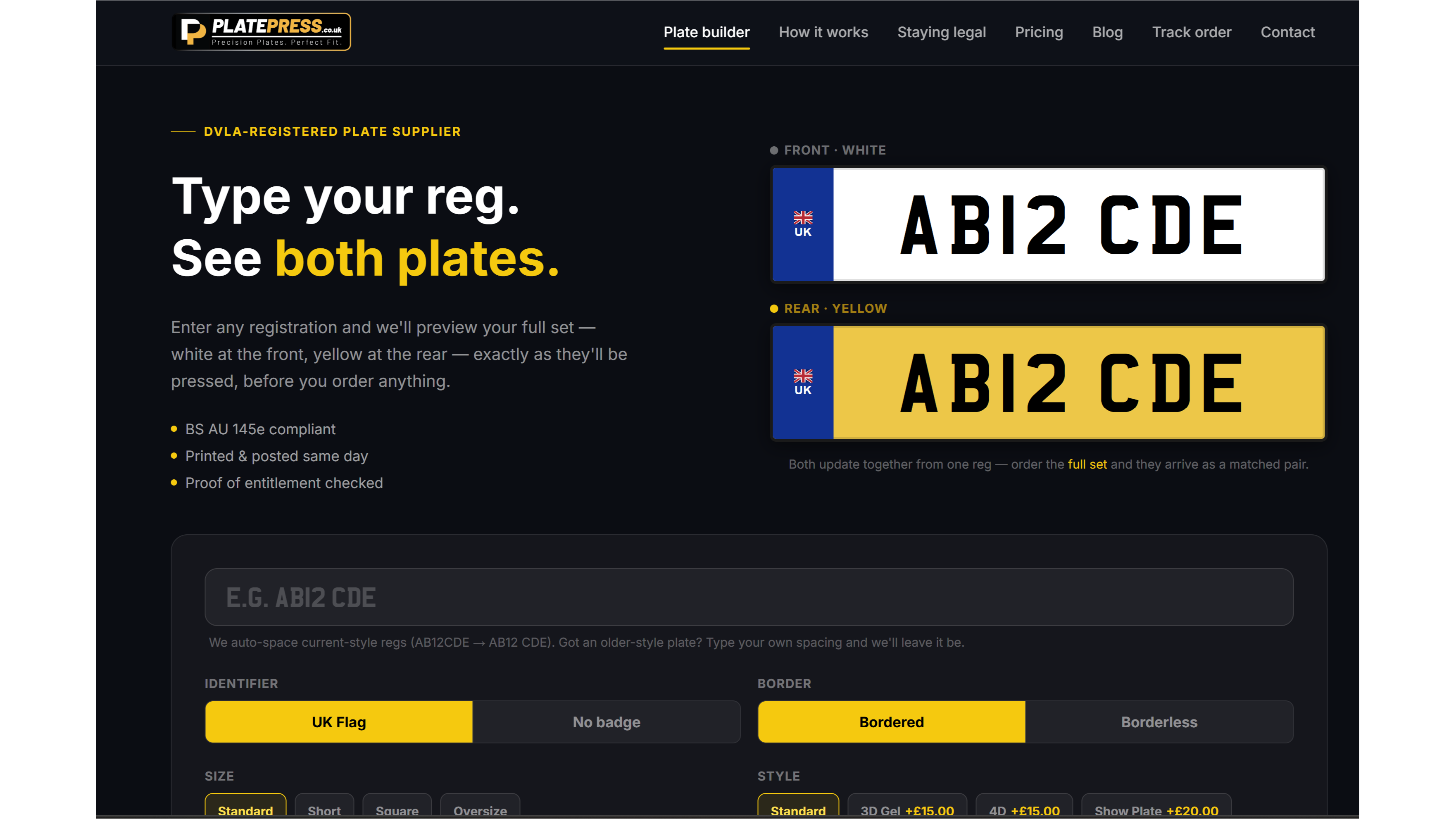
UK law is specific about what a road-legal plate must look like. Black characters on a white reflective background (front) and black characters on a yellow reflective background (rear) are the only permitted colour combinations. Show plates frequently use tinted backgrounds, coloured text, or decorative scripts – none of which are permitted. Even using the wrong font or an italic character style renders a plate non-compliant.
The ANPR Problem
Beyond aesthetics, there is a public safety reason behind these rules. Automatic Number Plate Recognition (ANPR) cameras – used by police and enforcement agencies across the UK – rely on plates being readable in a consistent, standardised format. Tinted backgrounds reduce reflectivity. Non-standard fonts disrupt character recognition. Any modification that hinders an ANPR camera’s ability to read a plate is, by definition, illegal. Show plates, designed without these requirements in mind, routinely fall foul of this standard.
What Makes a Plate Road-Legal in the UK
BS AU 145e: The Mandatory Standard
BS AU 145e is the British Standard that all road-legal number plates fitted after 1 September 2021 must comply with. It sets mandatory requirements for durability, reflectivity, and visibility – not just how a plate looks, but how it performs over time and in varying conditions. The standard was introduced to improve public safety and make plates more consistently readable by ANPR systems.
Correct Colours, Font, and Spacing
The legal requirements go into precise detail. The prescribed typeface is Charles Wright 2001 – no other font is permitted. Character height, width, stroke thickness, and the spacing between individual characters and groups are all fixed values. Even a small deviation in spacing is enough to make a plate non-compliant. Consistent formatting is what allows both humans and cameras to read plates quickly and accurately.
Supplier ID on the Plate Itself
Every road-legal plate must display the supplier’s name and postcode, along with the British Standard reference – BS AU 145e – printed directly on the plate. This requirement exists so that any plate can be traced back to the supplier who made it. Under UK law, all registered suppliers – including Platepress Ltd. on Anlaby Road in Hull – must verify a customer’s proof of identity and proof of entitlement to the registration number before producing any plate. A plate without supplier details is an immediate red flag and an immediate legal failure.
3D and 4D Plates: Road-Legal or Not?
This is one of the most common questions around modern number plates, and the answer is straightforward: 3D and 4D plates can be road-legal. The raised or gel characters that give these plates their distinctive look do not automatically make them non-compliant – but every other requirement must still be met. The characters must be solid black, the font must be Charles Wright 2001, spacing must be correct, and the plate must carry the supplier’s details and BS AU 145e marking. A 3D plate with a tinted background or non-standard font remains illegal regardless of how it is constructed. The finish is permitted; cutting corners on the standard is not.
The Real Cost of Getting It Wrong
Fines, MOT Failures, and Insurance
The £1,000 fine and MOT failure risk are the most visible consequences – but they are not the only ones. Driving with an illegal plate can invalidate a vehicle’s insurance policy, which turns a compliance issue into a potentially serious financial problem in the event of an accident. There are also complications at the point of sale, since a non-compliant plate can raise questions about the car’s history. In more serious cases – particularly where plates are modified to evade recognition – there is the risk of criminal charges for offences such as vehicle cloning. What starts as a style choice can escalate quickly.
Even minor deviations count. A missing supplier ID, slightly incorrect character spacing, or a background that does not meet reflectivity standards are all enough to make a plate non-compliant – even if it otherwise looks the part. The law does not make allowances for plates that are nearly right.
Get Legal Replacement Plates in Hull Today
For vehicle owners in Hull who need replacement plates, getting it right does not have to be complicated. Working with a registered supplier means the compliance side is handled correctly from the start – correct font, correct colours, correct spacing, supplier ID on the plate, and the necessary identity checks completed before manufacturing begins. The result is a plate that is legal to display on the road and will not create problems at the next MOT or traffic stop.
The distinction between a show plate and a road-legal plate is clearer than it might seem, but it matters enormously. Knowing the difference and acting on it is the straightforward way to avoid an entirely preventable fine.
Platepress Ltd. on Anlaby Road, Hull, supplies fast, road-legal replacement number plates for vehicle owners who want compliance handled properly.
Platepress Ltd.
+44 7535 247808
Plate Press
682 Anlaby Road
Hull
East Yorkshire
HU3 6UZ
United Kingdom


