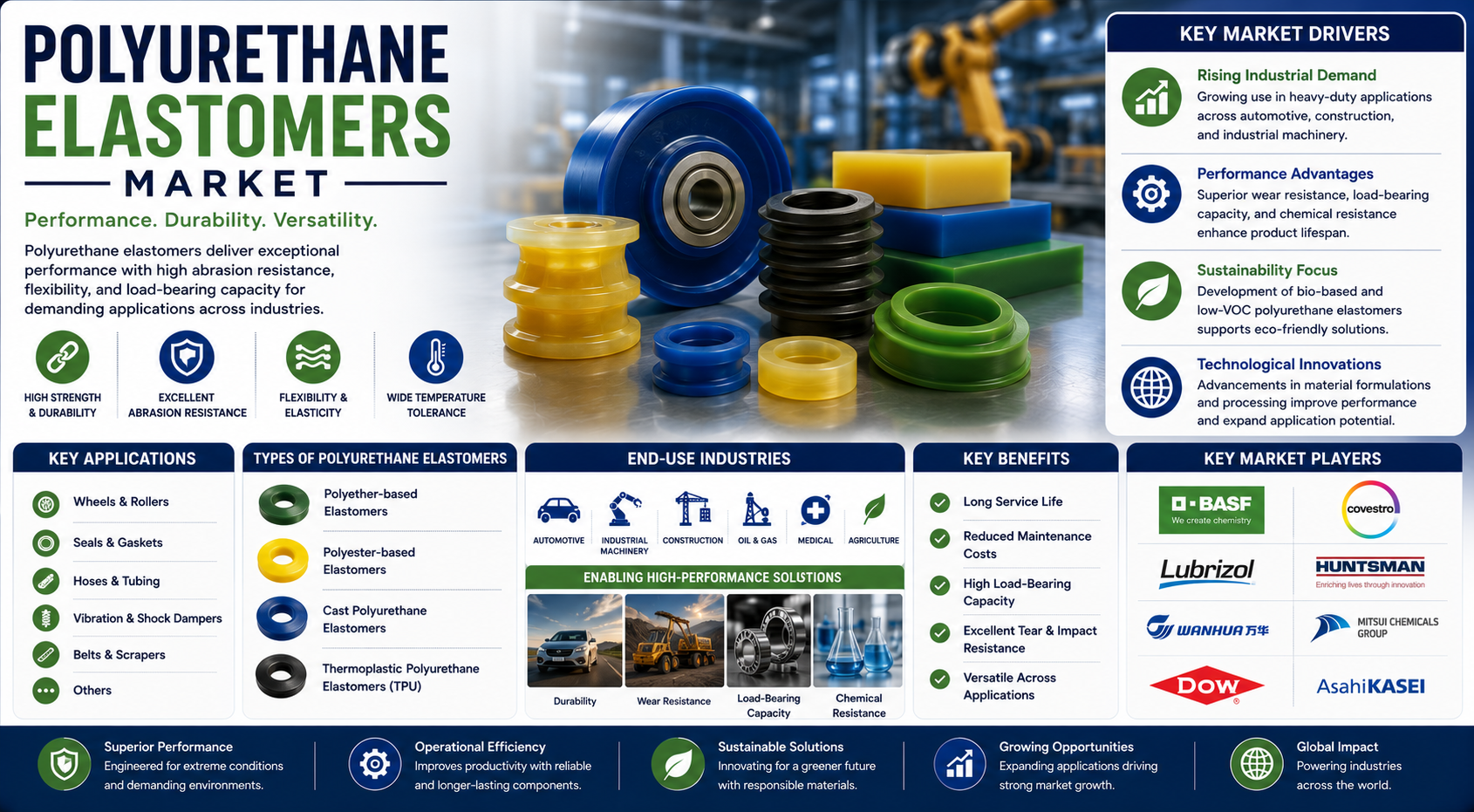
North America’s Polyurethane Elastomers Market is valued at approximately USD 0.94 billion.
CA, UNITED STATES, July 23, 2026 /EINPresswire.com/ — Polyurethane elastomers rarely get noticed—they’re the midsole cushioning a runner never thinks about, the bushing absorbing a suspension jolt, the roller lining keeping a mine conveyor running for another shift. Quiet as the category is, it’s compounding steadily. According to a report by Market Research Future (MRFR), the global polyurethane elastomers market reached an estimated USD 4.97 billion in 2025 and is projected to grow from USD 5.15 billion in 2026 to USD 7.08 billion by 2035, registering a compound annual growth rate of 3.6%. The growth isn’t dramatic by specialty-chemical standards, but it’s remarkably broad-based—anchored simultaneously by footwear manufacturing expansion in Asia, vehicle lightweighting mandates in the West, and an emerging bio-based reformulation wave that’s starting to reprice the entire category.
Footwear and Lightweighting: Two Very Different Growth Engines
The polyurethane elastomers market is being pulled forward by drivers that don’t share much in common except their reliance on the same chemistry. On one end, global footwear production surpassed 24 billion pairs in 2024, and between 2022 and 2024, fourteen new large-scale footwear plants opened in Vietnam, Indonesia, and India—each one locking in a recurring PU elastomer feedstock contract. That demand corridor alone accounts for an estimated 22% of the market’s growth impulse through 2028.
On the other end, automotive lightweighting mandates are reshaping a completely different part of the market. The EU’s Euro 7 emissions package and the U.S. CAFE standards revision to 50.4 mpg by 2031 are pushing OEMs to swap metal brackets, bushings, and dampers for polyurethane components that shave 30–40% off part weight. It’s a slower-moving driver than footwear, but a structurally durable one—automotive and transportation is now the fastest-growing application segment in the market, expanding at roughly a 3.9% CAGR.
Infrastructure spending rounds out the demand picture. Asia-Pacific governments have committed more than USD 1.8 trillion in infrastructure capital expenditure through 2030, and polyurethane elastomers show up in bridge bearings, expansion joints, and pipe seals—linking macro construction cycles directly to elastomer demand.
Get Report Sample Copy with TOC: https://www.marketresearchfuture.com/sample_request/4487
Thermoset Still Dominates, but Thermoplastic Is the Growth Story
By chemistry type, thermoset polyurethane elastomers hold roughly 63% of global revenue, a position built on cast molding’s ability to deliver large-format, customizable-hardness parts—roller covers, pipe linings, wear plates—across a Shore A 20 to Shore D 75 range that thermoplastic processing simply can’t match economically. Mining, oil & gas, and heavy construction remain thermoset’s stronghold.
Thermoplastic polyurethane (TPU), though, is growing faster, at an estimated 4.1% CAGR through 2035. Its melt-processability suits high-volume automotive and consumer-electronics production, where cycle time and recyclability matter more than raw mechanical performance. As OEMs push for closed-loop material streams, TPU is positioned to keep gaining share at thermoset’s expense over the next decade.
Footwear Still Leads Applications, but Automotive Is Closing the Gap
Footwear remains the single largest application, valued at approximately USD 1.74 billion in 2025—PU-soled products deliver a cushioning-to-durability balance that rubber and EVA struggle to match at the same price point, and athletic brands are now investing heavily in microcellular PU midsole foams for energy return.
Industrial machinery accounts for roughly 22% of total demand, driven by conveyor rollers, seals, and wheels that benefit from PU’s abrasion resistance. But automotive and transportation, growing at roughly 3.9% CAGR, is the segment redefining the market’s future—EV battery module cushioning, autonomous-vehicle sensor housing gaskets, and aerodynamic underbody panels are all new applications that didn’t exist in prior vehicle platforms.
Purchase Now: https://www.marketresearchfuture.com/checkout?currency=one_user-USD&report_id=4487
Regional Dynamics: Asia-Pacific’s Manufacturing Gravity
Asia-Pacific commands roughly 45% of global consumption, with China alone producing more than half the world’s footwear and anchoring the region’s demand base. India is closing the gap fastest, growing at an estimated 5.1% CAGR as the “Make in India” initiative pulled in USD 3.2 billion in polymer and chemical plant investment between 2022 and 2025.
Europe holds about 24% share, and it’s the region where sustainability-led reformulation is most aggressive—the EU Chemicals Strategy for Sustainability is pushing producers toward low-VOC, recyclable elastomer systems. Germany’s automotive Tier-1 supplier base alone consumed an estimated 65,000 tonnes of PU elastomers in 2024.
North America sits at roughly 19% share, worth about USD 0.94 billion, buoyed by reshoring trends and USD 52 billion in Inflation Reduction Act incentives channeled toward advanced manufacturing—much of it flowing into EV battery enclosure and suspension-component supply chains.
The Middle East & Africa region, though smallest in absolute terms, is projected to grow fastest of all at roughly a 4.3% CAGR, powered by Saudi Arabia’s Vision 2030 construction pipeline—over USD 500 billion committed to infrastructure and entertainment projects that consume PU sealants, flooring, and pipe gaskets.
What’s Working Against the Market
The polyurethane elastomers market’s biggest headwind is isocyanate price volatility. MDI and TDI, the two core building blocks, swung 25–40% in price between 2021 and 2024 due to petrochemical feedstock swings and force-majeure events at major Chinese and European production sites—squeezing margins hardest for smaller formulators without backward integration into their own isocyanate supply.
UV and thermal degradation limit PU elastomers’ penetration into certain outdoor and under-hood automotive applications, since properties measurably degrade above 120°C with prolonged sun exposure; additive stabilizer packages help, but at a formulation cost that erodes the material’s price-performance edge.
Regulation adds a third drag: the EU’s revised Occupational Exposure Limits Directive, effective August 2023, cut permissible workplace diisocyanate concentrations, forcing facility upgrades estimated at EUR 50,000–200,000 per production line—a cost that falls disproportionately on smaller European producers and slows capacity expansion in the region.
Read More: https://www.marketresearchfuture.com/reports/polyurethane-elastomers-market-4487
Where the Growth Is Building
The clearest near-term opportunity is bio-based and recycled-content polyurethane. Consumer brands in footwear and automotive are now setting 30–50% recycled-content targets by 2030, and producers who commercialize bio-polyol routes or chemical recycling of PU scrap stand to capture a premium pricing tier potentially worth USD 400–600 million by 2035. BASF and Covestro already operate demonstration plants converting PU waste back into polyols via glycolysis and hydrolysis, and an estimated 8–12% of European PU elastomer production could carry chemically recycled content by 2030.
Electric vehicle vibration management is the other major structural opportunity. EV powertrains generate distinct noise-vibration-harshness profiles compared to internal-combustion drivetrains, and each EV requires 15–25 custom elastomeric components for battery isolation and motor mounts that simply didn’t exist on ICE platforms. With the global EV fleet expected to surpass 250 million units by 2035, this is one of the largest incremental application corridors the market has seen in years.
Further out, smart elastomer systems—PU embedded with conductive nanofillers for real-time strain and pressure sensing—and a growing medical elastomer niche (catheter tips, prosthetic liners, wearable sensor housings, projected to reach USD 8.5 billion by 2032 as a broader category) point to a market that’s starting to diversify well beyond its industrial and footwear roots.
Competitive Landscape
The polyurethane elastomers market is lightly concentrated—an estimated HHI below 800, with the top five players holding just 35–40% of global revenue combined. BASF SE leads with its Elastollan TPU and Elastocast cast systems, distinguished by full-spectrum integration and active bio-based R&D; the company launched a 50%-bio-based, ISCC Plus-certified Elastollan grade in March 2025 aimed at footwear and consumer-electronics buyers. Covestro AG holds the technology edge in premium cast PU through its Desmopan and Vulkollan lines, while Wanhua Chemical Group has built cost leadership and Asia-Pacific dominance, reinforced by its January 2024 acquisition of a Hungarian MDI facility that extended its European isocyanate footprint.
Huntsman Corporation rounds out the leading tier with its Adiprene and IROGRAN product lines, and signed a joint development agreement with a major European EV manufacturer in mid-2024 to co-develop battery cushioning systems—a clear signal of where the growth incentives point. Dow Inc. and Lanxess AG compete on feedstock integration and mining-sector cast elastomers respectively, while The Lubrizol Corporation has carved out a defensible medical-grade niche, clearing FDA 510(k) approval for a radiopaque catheter-grade TPU in late 2024. Smaller specialists—Mitsui Chemicals in Japanese electronics and automotive, Tosoh Corporation in industrial and construction, Coim Group in European specialty formulation—fill out a field still defined more by application-specific expertise than raw scale.
Related Report
Polyurethane Additives Market https://www.marketresearchfuture.com/reports/polyurethane-additive-market-4916
polyurethane adhesive market https://www.marketresearchfuture.com/reports/polyurethane-adhesive-market-30733
Polyurethane Elastomers Market https://www.marketresearchfuture.com/reports/polyurethane-elastomers-market-4487
Polyurethane Dispersion Market https://www.marketresearchfuture.com/reports/polyurethane-dispersion-market-4991
Polyurethane Coatings Market https://www.marketresearchfuture.com/reports/polyurethane-coatings-market-2976
Expanded Thermoplastic Polyurethane Market https://www.marketresearchfuture.com/reports/expanded-thermoplastic-polyurethane-e-tpu-market-7731
Market Research Future
Market Research Future
+1 855-661-4441
email us here
Legal Disclaimer:
EIN Presswire provides this news content “as is” without warranty of any kind. We do not accept any responsibility or liability
for the accuracy, content, images, videos, licenses, completeness, legality, or reliability of the information contained in this
article. If you have any complaints or copyright issues related to this article, kindly contact the author above.

Media gallery