GA, UNITED STATES, July 6, 2026 /EINPresswire.com/ — The interface between rigid electronic devices and soft, dynamic human tissues has long been a fundamental obstacle in bioelectronic medicine. Now, a comprehensive review outlines how direct-ink writing (DIW) 3D printing of hydrogel-based bioelectronics is poised to overcome this challenge. By digitally programming the deposition of specialized hydrogel inks, researchers can now fabricate devices that seamlessly conform to organs, record electrical signals with high fidelity, and deliver precise therapeutic stimulation—all while minimizing tissue damage and inflammation. This manufacturing approach represents a paradigm shift toward truly personalized, long-lasting bioelectronic interfaces.
Traditional bioelectronic devices—made from silicon, metals, and other rigid materials—have long been indispensable for monitoring and treating conditions from Parkinson’s disease to cardiovascular disorders. Yet their mechanical stiffness creates a fundamental mismatch with soft, constantly moving tissues. This incompatibility leads to stress at the interface, chronic inflammation, scar tissue formation, and progressive device degradation over time. Compounding the problem, biological systems transmit signals through ions and molecules, while conventional electronics rely on electrons—a disconnect that weakens signal quality and limits therapeutic precision. These challenges call for an in-depth investigation into the design of intelligent hydrogel inks that can simultaneously satisfy requirements for printability, electrical conductivity, tissue adhesion, and biocompatibility.
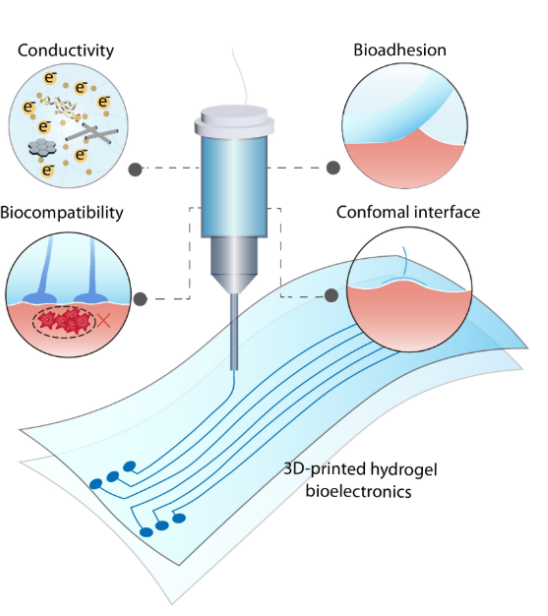
Researchers from Jiangxi Science and Technology Normal University and Southern University of Science and Technology have published (10.1007/s10118-026-3570-4) a comprehensive review on the use of direct-ink writing (DIW) 3D printing for hydrogel bioelectronics. The findings appear in the Chinese Journal of Polymer Science. The review systematically examines how hydrogel inks can be engineered to balance competing requirements—printability, electrical conductivity, tissue adhesion, and biocompatibility—while highlighting cutting-edge wearable and implantable devices for sensing and therapy.
The review’s central insight lies in the sophisticated design of hydrogel inks that can do it all. These inks must exhibit shear-thinning behavior—flowing easily through fine nozzles during printing but solidifying instantly upon deposition to maintain precise 3D structures. For bioelectronic function, the team highlights conductive polymers such as poly(3,4-ethylene dioxythiophene):poly(styrene sulfonate) (PEDOT:PSS) as a leading material platform. Notably, PEDOT:PSS-based inks have demonstrated conductivities up to 28 S·cm⁻¹ while achieving printing resolutions around 30 micrometers—fine enough to record signals from individual neurons. Perhaps most critically, the review emphasizes tissue adhesion as a non-negotiable design criterion. Bioadhesive hydrogels incorporating polymers such as poly(acrylic acid)-N-hydroxysuccinimide (PAA-NHS), chitosan (CTS), and poly(vinyl alcohol) (PVA) have achieved interfacial toughness of approximately 200 J·m⁻², enabling stable adhesion to beating hearts and other dynamically moving organs without delamination. In real-world applications, DIW-printed hydrogel electrodes have boosted electromyography (EMG) signal-to-noise ratios by 88% compared to commercial electrodes and maintained stable epicardial electrocardiogram (ECG) recordings for over 10,000 beating cycles. The technology has also enabled low-voltage cardiac pacing (around 0.7 V) and shown promise in wound healing, stroke rehabilitation, and real-time biosensing of biomarkers such as glucose and lactate.
“The key is that we’re no longer choosing between performance and biocompatibility—we can have both,” the authors said. “With DIW 3D printing, we can digitally design hydrogel inks that flow like liquids during printing but become soft, sticky, and electrically active implants afterward. This gives us unprecedented control over how these devices interact with the body, from the macro-scale down to the single-neuron level. The vision is to create bioelectronic systems that the body doesn’t reject but rather embraces as part of itself.”
The implications extend far beyond the laboratory. For patients with cardiac arrhythmias, these soft, adhesive electrodes could replace bulky pacemakers with interfaces that move naturally with the heart. For individuals with spinal cord injuries or stroke, precisely targeted neural stimulation could restore lost function. In wound care, electrical stimulation delivered through conformable hydrogel patches accelerates healing—particularly in difficult-to-treat diabetic wounds. And with the ability to print multi-electrode arrays for simultaneous detection of multiple biomarkers, these devices could enable continuous, real-time health monitoring that is both comprehensive and comfortable. As the authors note, the ultimate goal is a future where bioelectronic devices are not just implanted but truly integrated—moving, growing, and healing with the patients they serve.
DOI
10.1007/s10118-026-3570-4
Original Source URL
https://doi.org/10.1007/s10118-026-3570-4
Funding Information
This work was financially supported by the National Natural Science Foundation of China (Nos. 52373139 and U2436202), the Natural Science Foundation of Jiangxi Province (Nos. 20252BAC200300 and 20252BEJ730346), and a research startup grant (No. 2024BSQD15) from Jiangxi Science & Technology Normal University.
Lucy Wang
BioDesign Research
email us here
Legal Disclaimer:
EIN Presswire provides this news content “as is” without warranty of any kind. We do not accept any responsibility or liability
for the accuracy, content, images, videos, licenses, completeness, legality, or reliability of the information contained in this
article. If you have any complaints or copyright issues related to this article, kindly contact the author above.

Media gallery