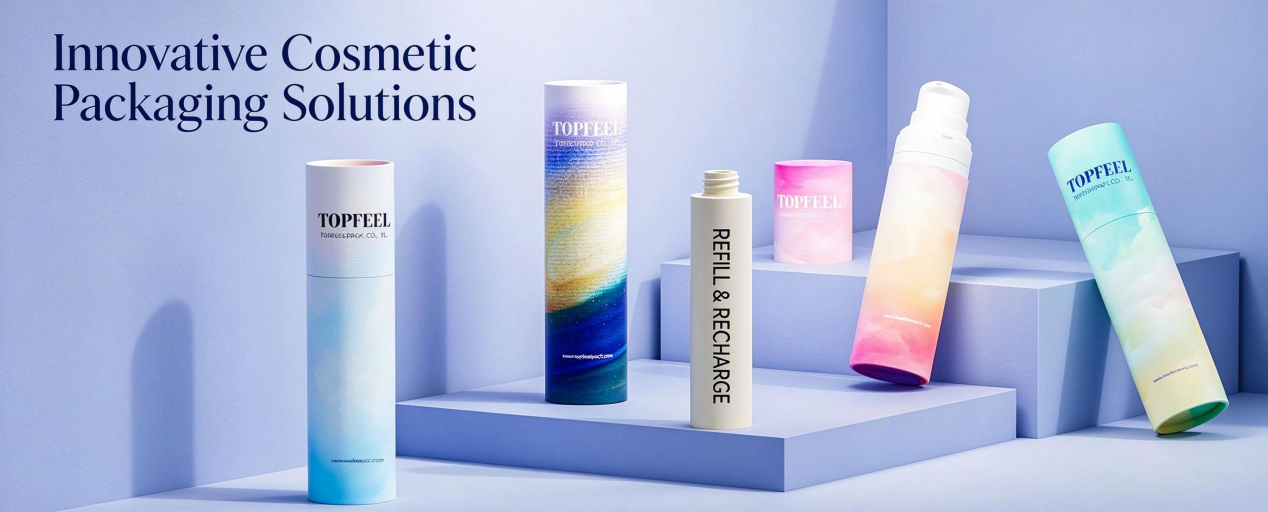
SHENZHEN, GUANGDONG, CHINA, November 24, 2026 /EINPresswire.com/ — In the contemporary beauty and personal care sector, the window between trend identification and retail launch has narrowed considerably. Formulators and brand managers face simultaneous demands: active ingredients such as retinoids, peptides, and vitamin C derivatives require high-barrier protection against oxidation, while global consumers and regulators demand verifiable reductions in virgin plastic waste. Within this ecosystem, packaging is no longer a passive vessel selected at the end of formulation; it is a primary driver of product stability, regulatory compliance, and speed to market. Bridging the gap between laboratory formulation and commercial scalability requires collaboration with an Innovative Cosmetic Packaging Solutions Provider capable of integrating structural engineering, material science, and agile manufacturing into a single workflow.
TOPFEELPACK CO., LTD operates at this intersection of packaging R&D, precision manufacturing, and global supply chain management. Serving beauty brands across Europe, North America, Australia, and other international markets, the company structures its operations around a one-stop service model. Rather than forcing brands to coordinate separately with industrial designers, mold makers, resin suppliers, and decorators, Topfeelpack consolidates concept development, material selection, tooling, mass production, surface decoration, quality assurance, and logistics under one roof. This integrated architecture reduces communication friction and shortens development cycles for both emerging indie labels and established multinational cosmetic enterprises.
Streamlining R&D Through Rapid Prototyping and One-Stop Engineering
Traditional cosmetic packaging development often stalls during the transition from industrial design to functional tooling. A concept that looks compelling in a 2D rendering may encounter sealing failures, pump actuation issues, or viscosity mismatches once paired with an actual skincare emulsion. Accelerating modern beauty product R&D requires early-stage validation before committing capital to high-cavitation production molds.
To address this bottleneck, Topfeelpack emphasizes a “Speed to Market” engineering framework built on rapid design iteration and prototyping. Utilizing rapid prototyping technologies, engineering teams translate initial brand briefs into tangible, testable prototypes. Brand R&D teams can evaluate ergonomics, dispensing dosage accuracy, and formula-to-package compatibility early in the product lifecycle.
Once a structural design is validated, in-house tooling workshops and automated injection and blow-molding lines transition the project into pilot runs and commercial manufacturing. By housing mold fabrication, assembly, and secondary decoration-such as silk-screen printing, hot stamping, spray coating, and metallization-within controlled production environments, the manufacturer minimizes transit delays and maintains tight dimensional tolerances across complex multi-component assemblies.
Core Packaging Architectures and Material Innovation
Different cosmetic formulations dictate specific mechanical and barrier requirements. A comprehensive packaging portfolio must balance functional preservation with aesthetic differentiation across multiple product categories:
Airless Dispensing Systems: Designed for oxygen-sensitive serums, moisturizers, and medical-grade skincare, airless bottles utilize a vacuum-driven piston or collapsible inner pouch to dispense product without allowing ambient air to enter the chamber. This mechanism preserves active ingredient potency, reduces the need for synthetic preservatives, and achieves evacuation rates often exceeding 95 percent.
Refillable and Hybrid Structures: Addressing single-use packaging waste without sacrificing shelf presence, modern refillable systems separate the durable outer shell from the replaceable inner cartridge. For example, innovations such as paper-shell refillable airless bottles combine a rigid kraft or decorative paper exterior with an interchangeable PP or PCR inner refill bottle and pump assembly, reducing overall plastic weight while allowing consumers to retain the outer vessel.
Mono-Material and PCR Formats: Conventional pumps and dispensers often combine polypropylene (PP), polyethylene (PE), polyoxymethylene (POM), and stainless steel springs, complicating municipal recycling streams. Replacing metal springs with engineered polymer springs yields 100 percent mono-material PP or PE dispensers. Alongside post-consumer recycled (PCR) resins, these structures align packaging hardware with circular economy infrastructure.
Versatile Primary Containers: Beyond specialized airless units, comprehensive catalog offerings span dropper bottles for low-viscosity oils, dual-chamber bottles for reactive two-part formulas, cosmetic tubes, lotion pumps, cream jars, and solid stick applicators for balms and sunscreens.
Navigating European PPWR and Global Regulatory Alignment
For beauty brands distributing in the European Union, packaging engineering is directly shaped by the Packaging and Packaging Waste Regulation (PPWR). Unlike earlier directives that allowed broad national interpretation, PPWR introduces binding requirements across the EU regarding recyclability performance grades, minimum PCR content thresholds for plastic packaging, packaging minimization to eliminate unnecessary empty space, and harmonized labeling.
Developing compliant packaging requires proactive alignment between supplier material specifications and brand regulatory teams. Topfeelpack actively develops packaging solutions and technical documentation tailored to PPWR readiness for European beauty brands. This includes prioritizing mono-material polymer architectures (such as all-PP airless bottles and jars), offering verified PCR resin integration in customizable ratios, and engineering lightweight wall thicknesses that pass drop and leak testing without excess material mass. Equally critical for compliance audits is documentation: suppliers must provide clear material composition breakdowns, resin traceability records, and test reports that enable brand owners to substantiate recyclability and sustainability claims to European authorities.
Frequently Asked Questions on Compliance, Testing, and Sourcing
What certifications and quality standards should beauty brands look for in a cosmetic packaging supplier? International beauty brands typically verify that their packaging partners operate under ISO 9001 for quality management systems, alongside Good Manufacturing Practice (GMP) standards relevant to cosmetic primary packaging. Depending on market distribution, suppliers should also provide Material Safety Data Sheets (MSDS), FDA food-contact grade compliance documentation for resins (such as PP, PE, and PETG), and SVHC (Substances of Very High Concern) compliance under EU REACH regulations.
How does Topfeelpack support European beauty brands preparing for PPWR compliance? Support focuses on both physical packaging design and technical documentation. On the structural side, engineering teams provide mono-material PP and PE containers, refillable cartridges, and packaging incorporating certified PCR content to meet upcoming EU recyclability and recycled-content mandates. On the administrative side, the company supplies detailed bill-of-materials (BOM) data, resin certifications, and packaging weight specifications required for European Extended Producer Responsibility (EPR) and PPWR technical files.
Can PCR plastics and mono-material pumps maintain the same formula stability as virgin plastics? Yes, when properly formulated and tested. Food-grade and cosmetic-grade PCR resins undergo decontamination and sorting processes to ensure chemical stability and low odor. Similarly, all-plastic mono-material pumps replace internal metal springs with precision-molded polymer springs that deliver reliable actuation force and elastic recovery. However, because PCR resins can exhibit slight variations in natural tint and barrier properties, compatibility and stability testing with the specific cosmetic formula is recommended during the R&D phase.
What testing is required to ensure an airless bottle will not leak during international air shipping? Airless and standard dispensing systems undergo vacuum chamber leak testing, typically simulating low-pressure environments equivalent to high-altitude cargo holds (such as -0.06 MPa to -0.08 MPa for defined durations). Additional validation includes torque testing on threaded closures, vertical drop testing from standard handling heights, and compatibility testing where filled containers are stored at elevated temperatures (e.g., 45 degrees Celsius) to check for stress cracking or seal degradation.
How quickly can a brand move from a custom packaging concept to physical samples? Sample production generally takes 7 to 14 business days.
Are refillable cosmetic packaging formats cost-effective for mid-sized beauty brands? Refillable packaging involves a slightly higher initial unit cost due to the dual-component architecture of the outer shell and inner refill pod. However, repeat purchases of lightweight refill cartridges lower ongoing manufacturing, resin, and freight expenses over the product lifecycle. Brands can also leverage existing stock outer shells paired with standard inner cartridges to minimize upfront tooling investments while offering a sustainable consumer experience.
Evaluating Packaging Specifications for Upcoming Product Launches
Selecting the right dispensing mechanism and material profile early in the formulation timeline prevents late-stage reformulation and supply chain delays. Whether developing a high-potency anti-aging serum requiring a 30ml or 50ml mono-material airless bottle with 30 percent PCR content, or transitioning a daily moisturizer line to a refillable jar architecture compliant with European PPWR guidelines, aligning structural specifications with R&D milestones is essential. Beauty brands, product developers, and procurement teams seeking technical datasheets, material compatibility samples, or custom tooling consultations can explore available packaging architectures and engineering capabilities directly via the official website at https://www.topfeelpack.com/
Topfeelpack
Topfeelpack
email us here
Legal Disclaimer:
EIN Presswire provides this news content “as is” without warranty of any kind. We do not accept any responsibility or liability
for the accuracy, content, images, videos, licenses, completeness, legality, or reliability of the information contained in this
article. If you have any complaints or copyright issues related to this article, kindly contact the author above.

Media gallery