Advancing life-science research with high-quality recombinant protein manufacturing and rigorous functional validation
HUSTON, TX, UNITED STATES, November 23, 2026 /EINPresswire.com/ — High-quality protein reagents lay a critical foundation for advancing life-science exploration and biopharmaceutical innovation. Reliable protein supplies underpin disease mechanism dissection, diagnostic assay development and vaccine candidate evaluation. This news release illustrates how Cloud-Clone translates lab-scale molecular biology know-how into scalable industrial-grade protein production, delivering well-characterized protein reagents that serve global research communities.
Main Body (Revised, compliant for international audience, advertising-law-friendly, no “domestic / domestic-China” wording; restructured following journalistic 10-principle & 5W2H logics without explicit mentioning of the framework itself)
Proteins serve as the direct functional executors of nearly all biological activities. From metabolic enzymes and signaling cytokines to structural collagens, almost every biological process depends on protein molecules. Within life-science research and biopharmaceutical industries, proteins act as essential core tools and raw materials. Investigators require large batches of high-purity and biologically active proteins for studying disease mechanisms, developing diagnostic reagents and engineering vaccine candidates.
Where do these research-grade proteins originate? How are they manufactured, validated, and deployed across thousands of research projects? This article walks through the protein “manufacturing workflow”, featuring product examples from Cloud-Clone to demonstrate how research-ready protein reagents evolve from laboratory concepts to mass-produced, essential resources for global research.
Proteins: Fundamental Building Blocks for Research and Industrial Applications
Proteins support a broad spectrum of research workflows. For fundamental biological studies, recombinant proteins are applied as immunization antigens for antibody generation, reference standards for assay establishment, and research materials for signaling-pathway profiling and protein-protein interaction analysis. In clinical diagnostics, protein antigens and antibody pairs constitute core raw materials for immunoassays, including key capture and detection components for ELISA platforms. Within biopharmaceutical sectors, proteins themselves can function as therapeutic agents, exemplified by insulin, interferons and monoclonal antibodies.
Consistent supply and controlled quality of protein reagents directly shape the progress of life-science investigations and biopharmaceutical development. Enterprises capable of stably delivering well-characterized protein portfolios therefore occupy an increasingly vital position within the global research ecosystem.
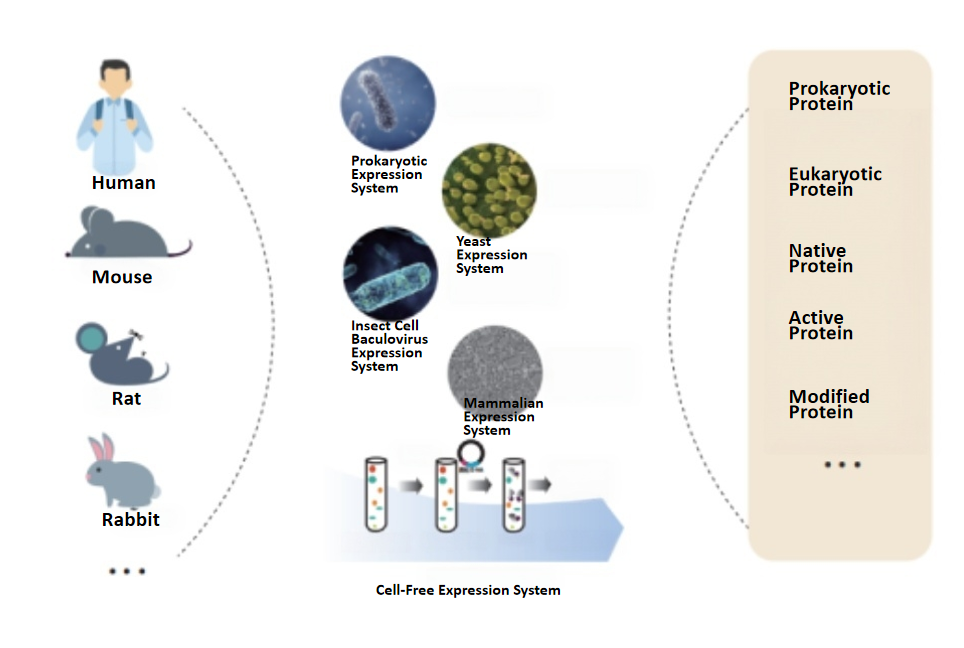
Figure Protein Classification
Sources of Research-Grade Proteins: An Overview of Five Major Expression Systems
Natural biological tissues yield limited amounts of native protein. Direct extraction from biological tissues frequently suffers from low yields, insufficient purity and elevated production costs. Modern biotechnology addresses these bottlenecks via recombinant expression: target-protein encoding genes are delivered into suitable host cells, turning individual cells into miniature biomanufacturing units for bulk protein generation.
Five mainstream protein expression platforms are widely adopted today:
– Prokaryotic Expression System: Represented by Escherichia coli, this is one of the earliest and most extensively deployed platforms. It features rapid host-cell propagation, low operational costs and high expression yields, making it suitable for producing structurally simple proteins. Nevertheless, E. coli lacks native eukaryotic post-translational modification machineries and cannot carry out complex processing such as glycosylation. Certain target proteins accumulate as biologically inactive inclusion bodies that require additional refolding workflows.
– Yeast Expression System: Combines the easy-to-culture properties of single-cell organisms with partial eukaryotic protein-processing capacity. It supports limited glycosylation modification and disulfide-bond formation. Pichia pastoris represents one of the most widely used industrial eukaryotic hosts; target proteins can be secreted into culture supernatants to simplify downstream purification workflows. Its glycosylation profile generates non-human high-mannose glycoforms, which may require glyco-engineering adjustments for therapeutic protein candidates.
– Insect Cell-Baculovirus Expression System: Delivers robust protein-processing capacity and is particularly well-suited for membrane proteins and targets requiring sophisticated modifications. It stands as a preferred choice for protein crystallization within structural biology research. Many protein targets that fail to produce soluble active products in E. coli can yield functional soluble proteins when produced in insect cell hosts.
– Mammalian Cell Expression System: Recreates biosynthetic environments closest to native human protein processing. It enables complex glycosylation and correct protein folding, establishing the gold-standard platform for therapeutic-protein manufacturing. HEK293 and CHO cell lines are commonly used hosts. HEK293 offers advantages for transient expression, while CHO cells represent the dominant industrial platform for biopharmaceutical production.
– Cell-Free Expression System: An in-vitro protein synthesis approach employing cell lysate translational machinery to assemble target proteins directly within reaction tubes. This platform excels at producing proteins toxic to living host cells, with turnaround times ranging from several hours to one day.
Each expression platform carries distinct strengths and limitations. Researchers select optimal production workflows according to target-protein characteristics, yield objectives and intended end-use scenarios. A full-spectrum multi-system expression capability serves as an important technical benchmark for protein reagent suppliers.
From Functional Feasibility to Reliable Performance: Activity Assays and Quality Control
Correct three-dimensional conformation and biological functionality define whether expressed proteins can support experimental workflows. Even high-purity misfolded proteins cannot exert expected biological functions. Biological-activity verification therefore forms the cornerstone of protein-product quality-control workflows.
Cloud-Clone implements a multi-faceted verification framework for active protein characterization, covering three major assay categories:
1.Stimulation-Activity Assays: Biological functionality is evaluated through cellular phenotypic responses. For instance, Cloud-Clone FGF17 active protein (Product ID: APC910Hu01) is validated via Balb/c 3T3 cell-proliferation assays using the CCK-8 detection method, demonstrating clear growth-promoting effects on target cells.
2.Binding-Activity Assays: Measure molecular-interaction performance between proteins and their corresponding receptors or ligands. ACE2 active protein (Product ID: APB886Mu01) is assessed by ELISA for binding toward recombinant S1 protein. Dose-dependent binding curves confirm intact molecular functionality.
3.Enzymatic-Activity Assays: Characterize catalytic performance for enzyme-derived protein products. CES1 active protein (Product ID: APC374Hu01) is tested by monitoring the hydrolysis of 4-nitrophenyl acetate (4-NPA) into 4-nitrophenol. A well-fitted standard curve (R²=0.9976) confirms consistent catalytic performance.
Cloud-Clone enforces three-tier quality benchmarks for its protein portfolio: purity ≥95% (measured by SDS-PAGE or HPLC), extremely low endotoxin levels (<0.01 EU/μg), plus documented biological-activity validation. All functional test records are fully archived and incorporated within product Certificates of Analysis (CoA) and product documentation, delivering dependable material support for cell-culture experiments, protein-function investigations and drug-screening campaigns.
Cloud-Clone: Continuous Technical Advancement for Global Protein Reagent Supply
Cloud-Clone Corp., based in Wuhan Economic & Technological Development Zone, holds high-tech-enterprise accreditation. The organization maintains ISO 9001 and ISO 13485 quality-management-system certifications. With an on-site animal-research facility holding relevant operational permits, Cloud-Clone maintains a complete in-house workflow spanning gene-sequence design through final protein manufacturing.
In terms of product portfolio, Cloud-Clone offers more than 18 000 recombinant-protein products, over 2 900 full-length protein constructs, and more than 1 300 functionally-validated active-protein items. The catalog covers more than ten species including human, mouse, rat, guinea pig, rabbit, dog, pig, bovine and goat, supporting diverse research and manufacturing applications across species. All protein products originate from internally curated proprietary gene libraries to secure authentic biological sources and accurate gene sequences.
For biomanufacturing infrastructure, Cloud-Clone operates comprehensive production platforms, including prokaryotic, yeast, insect-cell, HEK293 and CHO-based eukaryotic expression workflows. Leveraging industrial-scale production capacity, the team delivers stable batch outputs ranging from milligram to gram scales. Manufacturing processes follow GMP-compliant clean-area standards. Standardized production protocols minimize batch-to-batch variation and sustain consistent long-term product performance.
Growing citations in peer-reviewed SCI journals reflect academic recognition for Cloud-Clone reagents, with documented usage in high-impact publications including Nature, Cell, Immunity, Nature Communications and Advanced Science. Representative examples include recombinant Hemoglobin Alpha 1 (RPD090Mu01) and Hemoglobin Beta (RPD098Mu01) cited in Nature; active Perforin-1 (APB317Mu01) referenced in Nature Biomedical Engineering; and active SIRT3 (APE913Ra01) featured in Signal Transduction and Targeted Therapy. These high-profile publications demonstrate that Cloud-Clone reagents deliver reliable performance for cutting-edge scientific investigations.
Custom manufacturing services are also available. Custom project scopes include expression-platform selection, affinity-tag engineering and functional-activity validation to satisfy unique project-specific requirements. Specialized technical support provides responsive assistance for experimental troubleshooting.
Protein reagents remain foundational research tools and critical raw materials for biopharmaceutical innovation. Manufacturing and characterization workflows keep evolving continuously. Every step, from expression-system selection and purification-process refinement through functional-activity validation, builds upon accumulated technical expertise and strict quality standards.
Advanced protein reagents travel from digital gene sequences in laboratories to large-scale production-line deliveries. Cloud-Clone keeps optimizing its multi-platform expression workflows, functional-validation pipelines and batch consistency control. The company continues to supply trusted protein resources empowering global investigators to pursue new discoveries in life-science and translational biomedicine.
SuKi Duan
CLOUD-CLONE CORP.WUHAN
cro@cloud-clone.com
Visit us on social media:
LinkedIn
Instagram
TikTok
X
Legal Disclaimer:
EIN Presswire provides this news content “as is” without warranty of any kind. We do not accept any responsibility or liability
for the accuracy, content, images, videos, licenses, completeness, legality, or reliability of the information contained in this
article. If you have any complaints or copyright issues related to this article, kindly contact the author above.

Media gallery