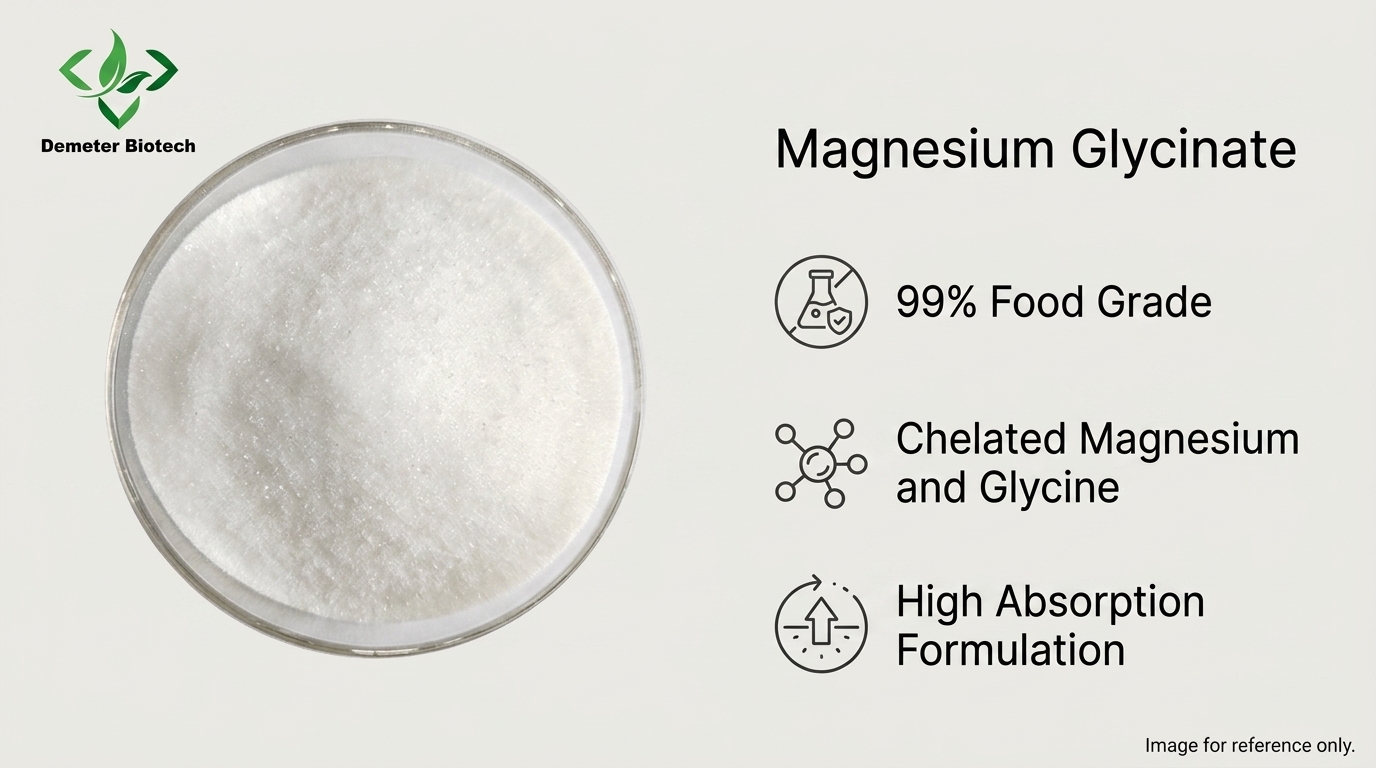
XI’AN, SHAANXI, CHINA, August 12, 2026 /EINPresswire.com/ — Choosing a magnesium source for a supplement formula is no longer a matter of comparing mineral names on a label. Formulators now weigh the raw material’s chemical form, its specification documents, batch traceability, and how well it will carry into later dosage development. High Absorption Magnesium Glycinate For Supplements answers that brief by pairing magnesium with glycine, giving brands that want strong absorption alongside a gentle formulation profile a clear ingredient direction. In practical terms, high absorption magnesium glycinate for supplements is a chelated form in which each magnesium ion is bound to glycine, an amino acid that supports uptake and tends to sit more comfortably with sensitive users.
Demeterherb offers three magnesium glycinate routes for supplement development: fully chelated magnesium glycinate with excellent taste, high solubility, and magnesium content of at least 20%; a mild type with magnesium content of 13%-14%; and liposomal magnesium glycinate. Supplied by Xi’an Demeter Biotech Co., Ltd., these defined options move the buying decision away from a vague promise of high absorption and toward specifications a procurement team can verify.
Why Magnesium Glycinate Is Selected for High-Absorption Supplement Formulas
The value of magnesium glycinate rests not in the mineral name alone but in the organic salt formed when magnesium bonds with glycine. That structure is what makes it a preferred choice for formulas built around absorption and tolerability, and it lets a formulation conversation move past the phrase contains magnesium into questions of form and application fit. Because glycine is a small, well-tolerated amino acid, the chelate also appeals to brands whose customers have found other magnesium salts harsh, which is often the deciding factor in categories such as sleep, relaxation, and daily wellness.
Demeterherb’s magnesium glycinate range is defined by formulation purpose and magnesium content. The fully chelated grade combines excellent taste and high solubility with magnesium content of at least 20%. The mild type provides magnesium content of 13%-14%, while liposomal magnesium glycinate offers a separate delivery format. For a supplement brand, these distinctions should be reviewed alongside the COA and product-development files rather than replaced by a single purity number.
Production Control Begins with a Defined Product Specification
In supplement ingredients, advanced production is less about unverified equipment claims than about organizing the product name, appearance, active ingredient, specification, test method, and supply documents into a repeatable delivery standard. The fully chelated grade with magnesium content of at least 20%, the mild type at 13%-14%, and liposomal magnesium glycinate give formulation, procurement, and quality teams a shared specification framework.
COA availability folds each batch’s documentation into the procurement loop, while a 24-month shelf life gives warehousing, production scheduling, and cross-border supply a clear time frame. Specification review should distinguish the fully chelated grade with magnesium content of at least 20% from the mild type at 13%-14%, because the two grades serve different formulation priorities. Liposomal magnesium glycinate should be reviewed as a separate delivery format. Demeterherb backs the supply program with GMP-standard factory production, ISO22000 certification, and private-label packaging.
Packaging and Documentation Support Bulk Ingredient Readiness
Steady supply depends not only on the ingredient specification but on whether the packaging configuration matches order volume, shipping route, and storage arrangements. Demeterherb lists packaging that includes a 1 kg aluminum foil bag with two plastic bags inside, along with a 25 kg carton or a 25 kg fiber drum with an inner aluminum foil bag, giving supplement buyers comparable baseline options across different order sizes.
Packaging details are best read together with the COA, batch identification, and incoming-goods inspection. For a brand pursuing private label or several dosage formats, the completeness of the ingredient documentation and the clarity of the packaging path decide whether later communication stays consistent instead of stalling after a single inquiry. The company’s custom services span hard capsules, soft capsules, tablets, and granules, so the packaging discussion can extend naturally into format planning. Smaller foil bags suit early trials and stability testing, while cartons and fiber drums fit repeat production orders, letting a brand keep the same qualified material as volumes grow.
A Practical Qualification Path for Supplement Brands
When a supplement brand screens magnesium glycinate, the ingredient form, magnesium-content specification, applicable test method, COA availability, shelf life, and packaging options belong inside one evaluation framework. The review should compare the fully chelated grade with at least 20% magnesium, the mild type at 13%-14%, and liposomal magnesium glycinate as separate options. A judgment built this way supports scaled purchasing, internal quality files, and continuity of supply.
Consider a mid-sized brand extending a sleep-and-recovery line. It needs an ingredient whose form supports absorption, whose paperwork clears internal quality review, and whose packaging suits both pilot runs and scale-up. A specification-led magnesium glycinate, ordered first as a 1 kg trial bag and later in 25 kg drums, lets that brand move from sample to production without renegotiating the fundamentals along the way.
Demeterherb’s mineral and nutritional ingredient range, combined with private-label packaging aimed at global customers, lets a magnesium glycinate conversation cover raw-material specifications and delivery requirements at the same time. For teams exploring formulation science, the company’s look at phospholipid encapsulation and magnesium-induced osmotic discomfort offers useful extended reading, though it should complement rather than replace a direct review of the magnesium glycinate specification and quality documents. Since 2017, Xi’an Demeter Biotech Co., Ltd. has served supplement, pharmaceutical, cosmetic, and beverage customers across more than 50 countries, giving newer brands a supplier with real export experience to lean on.
Bringing the Sourcing Decision Together
Taken together, fully chelated magnesium glycinate with at least 20% magnesium, a mild type with 13%-14% magnesium, liposomal magnesium glycinate, COA availability, a 24-month shelf life, and defined bulk packaging form an auditable basis for supplement ingredient sourcing. Demeterherb keeps clear product information, responsive service, and custom packaging at the center of a long-term supply relationship built on quality.
To request the specification, COA, and packaging details for magnesium glycinate, visit https://www.demeterherb.com/ to open an inquiry.
Xi’an Demeter Biotech Co., Ltd.
Demeterherb
email us here
Visit us on social media:
LinkedIn
Facebook
X
Legal Disclaimer:
EIN Presswire provides this news content “as is” without warranty of any kind. We do not accept any responsibility or liability
for the accuracy, content, images, videos, licenses, completeness, legality, or reliability of the information contained in this
article. If you have any complaints or copyright issues related to this article, kindly contact the author above.

Media gallery