Global heat exchanger market is projected to reach $33.2 billion by 2033 driven by industrial expansion.
WILMINGTON, DE, UNITED STATES, May 27, 2026 /EINPresswire.com/ —
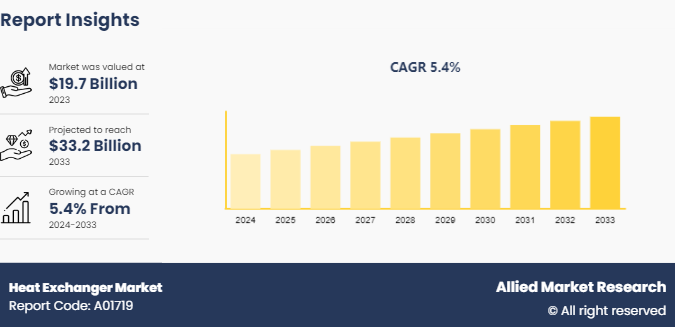
The global heat exchanger market is witnessing steady growth as industries increasingly prioritize energy efficiency, temperature control, and sustainable industrial operations. According to a recent report published by Allied Market Research, the global heat exchanger market size was valued at $19.7 billion in 2023 and is projected to reach $33.2 billion by 2033, registering a CAGR of 5.4% from 2024 to 2033.
The expansion of industrial infrastructure, growing energy demand, and rising investments in chemical processing, HVAC systems, and power generation facilities are among the major factors driving the heat exchanger market globally. Businesses across industries are increasingly adopting advanced heat transfer systems to improve operational efficiency, reduce energy losses, and enhance system reliability.
Download PDF Brochure: https://www.alliedmarketresearch.com/request-sample/2049
Overview of the Heat Exchanger Market
A heat exchanger is a mechanical device designed to transfer heat between two or more fluids without allowing them to mix. Heat exchangers are essential components in numerous industrial and commercial applications where temperature regulation and efficient heat transfer are required.
These systems operate based on thermodynamic principles, where heat naturally moves from a higher-temperature medium to a lower-temperature medium. Heat exchangers optimize this process while minimizing energy losses, helping industries improve overall energy efficiency.
The heat exchanger market plays a critical role in sectors such as chemical processing, petrochemicals, oil and gas, power generation, HVAC, food processing, refrigeration, and automotive manufacturing. As industrial operations become increasingly energy-intensive, demand for reliable heat transfer equipment continues to rise.
Growing Industrialization Driving Market Growth
Rapid industrialization across developing and developed economies is significantly supporting the expansion of the heat exchanger market. Industries worldwide are increasing production capacity to meet rising consumer demand for energy, chemicals, processed foods, transportation, and manufactured goods.
Heat exchangers are widely used in industrial facilities to maintain optimal temperatures during production processes, chemical reactions, cooling operations, and energy recovery systems. Their ability to improve process efficiency and reduce energy consumption makes them essential for modern industrial infrastructure.
The growth of manufacturing activities, urbanization, and infrastructure development projects is increasing demand for industrial heating and cooling systems globally. As industries continue expanding operations, the heat exchanger market is expected to experience sustained growth throughout the forecast period.
Chemical and Petrochemical Industry Fueling Demand
The expansion of the chemical and petrochemical sectors is one of the primary factors driving the heat exchanger market.
Chemical and petrochemical plants require highly efficient temperature management systems for processes such as distillation, separation, condensation, evaporation, and chemical reactions. Heat exchangers help maintain precise thermal conditions necessary for safe and efficient plant operations.
The rising global demand for chemicals, plastics, fertilizers, and refined petroleum products is encouraging companies to invest in new production facilities and expand existing operations. These investments are significantly increasing demand for advanced heat exchanger systems.
Heat exchangers also support energy recovery within chemical processing facilities by transferring excess heat between process streams, helping reduce operational costs and improve sustainability.
As industrial demand for chemical products continues rising worldwide, the heat exchanger market is expected to benefit substantially.
Power Generation Industry Supporting Market Expansion
The power generation sector represents another major contributor to the heat exchanger market. Power plants rely heavily on heat exchangers for cooling, steam generation, condensation, and thermal energy transfer operations.
Conventional thermal power plants, nuclear facilities, renewable energy systems, and combined cycle power stations all utilize heat exchanger technologies to improve energy efficiency and maintain operational stability.
The increasing global demand for electricity, coupled with investments in power infrastructure modernization, is driving adoption of high-performance heat exchanger systems.
Heat exchangers are also essential for renewable energy applications, including geothermal systems, concentrated solar power plants, and biomass energy facilities. The transition toward cleaner and more efficient energy systems is expected to create new opportunities for the heat exchanger market in the coming years.
HVAC Industry Creating Significant Opportunities
The growing HVAC industry is playing an important role in the expansion of the heat exchanger market.
Heating, ventilation, and air conditioning systems use heat exchangers for cooling, heating, refrigeration, and indoor air quality management. Rising urbanization, commercial construction, and residential infrastructure development are increasing demand for HVAC systems worldwide.
Energy-efficient building standards and environmental regulations are encouraging businesses and consumers to adopt advanced HVAC technologies that minimize energy consumption and improve thermal performance.
Heat exchangers used in HVAC systems help optimize energy usage while maintaining comfortable indoor temperatures in residential, commercial, and industrial buildings.
The increasing adoption of smart buildings and energy-efficient cooling systems is expected to further accelerate growth in the heat exchanger market.
Types of Heat Exchangers Used Across Industries
The heat exchanger market includes several product types designed for different industrial applications and operational requirements.
Shell-and-Tube Heat Exchangers
Shell-and-tube heat exchangers are among the most widely used systems in industrial applications. These systems consist of multiple tubes enclosed within a cylindrical shell. One fluid flows through the tubes while another fluid circulates around them, enabling efficient heat transfer.
Shell-and-tube heat exchangers are commonly used in oil and gas, petrochemical, power generation, and chemical processing industries due to their durability and ability to handle high pressures and temperatures.
Plate Heat Exchangers
Plate heat exchangers use thin metal plates arranged in layers to create multiple flow channels. This design provides a large surface area for efficient heat transfer while maintaining compact equipment dimensions.
These systems are widely used in HVAC, food processing, pharmaceuticals, and refrigeration applications because of their high thermal efficiency and ease of maintenance.
Air-Cooled Heat Exchangers
Air-cooled heat exchangers use ambient air to cool process fluids and are commonly used in industries where water availability is limited. These systems are increasingly adopted in oil and gas operations, power plants, and remote industrial facilities.
Microchannel Heat Exchangers
Microchannel heat exchangers are advanced systems designed for compact applications requiring high thermal performance. They are increasingly used in automotive air conditioning, refrigeration systems, and modern HVAC technologies.
The growing demand for energy-efficient and lightweight cooling systems is supporting adoption of microchannel heat exchangers globally.
Buy This Report (300 Pages PDF with Insights, Charts, Tables, and Figures): https://www.alliedmarketresearch.com/heat-exchanger-market/purchase-options
Advanced Materials Transforming the Market
The emergence of advanced materials is creating substantial opportunities within the heat exchanger market by improving equipment performance, durability, and efficiency.
Traditional materials such as carbon steel and stainless steel remain widely used; however, industries operating in harsh environments increasingly require specialized materials capable of withstanding extreme temperatures, high pressures, and corrosive conditions.
Innovations in material science have introduced advanced alloys, composites, titanium, aluminum, and nickel-based materials that offer improved corrosion resistance, thermal conductivity, and operational lifespan.
These advanced materials are particularly valuable in chemical processing, marine applications, offshore oil platforms, and high-temperature industrial environments.
The development of advanced coatings and corrosion-resistant technologies is also helping manufacturers enhance heat exchanger reliability and reduce maintenance requirements.
Rising Focus on Energy Efficiency
Energy efficiency has become a critical priority for industries worldwide, further driving growth in the heat exchanger market.
Businesses are increasingly implementing energy recovery systems and thermal management solutions to reduce operational costs and comply with environmental regulations. Heat exchangers enable efficient utilization of waste heat generated during industrial processes.
Energy-efficient heat exchanger systems help organizations reduce fuel consumption, lower greenhouse gas emissions, and improve overall process sustainability.
Government regulations promoting energy conservation and carbon emission reduction are encouraging industries to upgrade outdated equipment and invest in high-efficiency heat exchanger technologies.
The increasing emphasis on sustainable industrial operations is expected to remain a key growth driver for the heat exchanger market.
Challenges Limiting Market Growth
Despite strong growth potential, the heat exchanger market faces several challenges that may limit expansion.
One of the major restraints is the high initial cost associated with manufacturing and installing advanced heat exchanger systems. High-performance equipment often requires specialized materials, complex engineering, and skilled labor, increasing overall project expenses.
Industries operating under budget constraints may hesitate to invest in premium heat exchanger technologies despite their long-term efficiency benefits.
Maintenance and operational challenges can also impact market growth, particularly in industries dealing with highly corrosive or contaminated process fluids.
Additionally, fluctuations in raw material prices and supply chain disruptions may affect manufacturing costs and product availability within the heat exchanger market.
Food and Beverage Industry Supporting Adoption
The food and beverage sector is increasingly adopting heat exchanger technologies to improve processing efficiency, product quality, and energy management.
Heat exchangers are widely used for pasteurization, refrigeration, sterilization, heating, and cooling operations in food production facilities.
The growing demand for processed foods, packaged beverages, and cold chain logistics is increasing investment in thermal management equipment across the food industry.
Strict hygiene regulations and energy efficiency standards are also encouraging manufacturers to adopt advanced heat exchanger systems with improved sanitation and operational reliability.
Regional Analysis of the Heat Exchanger Market
Asia-Pacific Leading Industrial Growth
Asia-Pacific is expected to remain a major growth region within the heat exchanger market due to rapid industrialization, urbanization, and infrastructure development.
Countries such as China, India, Japan, and South Korea are investing heavily in manufacturing, power generation, petrochemicals, and HVAC infrastructure. Rising energy demand and industrial expansion are significantly increasing the need for heat exchanger systems across the region.
The growth of renewable energy projects and smart city developments is also contributing to increased adoption of advanced heat transfer technologies.
North America Maintaining Strong Market Presence
North America continues to hold a significant share of the heat exchanger market due to established industrial infrastructure and strong investments in energy-efficient technologies.
Industries across the United States and Canada are increasingly upgrading thermal management systems to improve operational efficiency and meet environmental compliance standards.
The region’s growing focus on clean energy, advanced manufacturing, and industrial modernization is supporting steady market growth.
Europe Focusing on Sustainable Technologies
Europe remains an important market for heat exchangers due to strict environmental regulations and increasing investments in sustainable industrial systems.
The region is witnessing strong demand for energy-efficient HVAC systems, renewable energy technologies, and industrial waste heat recovery solutions.
Government initiatives promoting carbon neutrality and green energy adoption are expected to continue driving market growth across Europe.
Competitive Landscape and Key Players
Major companies operating in the heat exchanger market are focusing on technological innovation, strategic partnerships, product development, and global expansion strategies to strengthen their market position.
Leading players in the heat exchanger market include Alfa Laval, API Heat Transfer, Chart Industries, Danfoss, Koch Industries, Xylem, Hisaka Works, and Thermofin.
These companies are investing in research and development activities to introduce advanced heat exchanger technologies with improved efficiency, durability, and environmental performance.
Get a Customized Research Report: https://www.alliedmarketresearch.com/request-for-customization/2049
Future Outlook of the Heat Exchanger Market
The future of the heat exchanger market appears highly promising as industries continue focusing on energy efficiency, industrial automation, and sustainable manufacturing practices.
The expansion of renewable energy projects, chemical processing facilities, HVAC infrastructure, and industrial modernization initiatives will continue driving demand for advanced heat exchanger systems globally.
Technological advancements in materials, thermal engineering, and compact system design are expected to improve heat exchanger performance and operational efficiency further.
As industries increasingly prioritize carbon reduction, waste heat recovery, and energy optimization strategies, the heat exchanger market is expected to remain a critical component of global industrial infrastructure through 2033 and beyond.
Trending Reports in Energy and Power Industry:
Heat Exchanger Market
https://www.alliedmarketresearch.com/heat-exchanger-market
Underfloor Heating Market
https://www.alliedmarketresearch.com/underfloor-heating-market-A06488
District Heating and Cooling Market
https://www.alliedmarketresearch.com/district-heating-and-cooling-market-A323710
Gasketed Plate Heat Exchanger Market
https://www.alliedmarketresearch.com/gasketed-plate-heat-exchanger-market-A31025
India Heat Exchangers Market
https://www.alliedmarketresearch.com/india-heat-exchangers-market
Brazed Plate Heat Exchangers Market
https://www.alliedmarketresearch.com/brazed-plate-heat-exchangers-market-A12846
Taiwan Commercial Air Conditioning System Market
https://www.alliedmarketresearch.com/taiwan-commercial-air-conditioning-system-market-A325817
Air Conditioning Equipment Market
https://www.alliedmarketresearch.com/air-conditioning-equipment-market
Commercial Air Conditioning System Market
https://www.alliedmarketresearch.com/commercial-air-conditioning-system-market-A78146
Heating, Ventilation, and Air Conditioning Equipment Market
Industrial Heat Pump Market
https://www.alliedmarketresearch.com/industrial-heat-pump-market-A47269
Heat Pump Market
https://www.alliedmarketresearch.com/heat-pump-market
About Us
Allied Market Research (AMR) is a full-service market research and business-consulting wing of Allied Analytics LLP based in Portland, Oregon. Allied Market Research provides global enterprises as well as medium and small businesses with unmatched quality of “Market Research Reports” and “Business Intelligence Solutions.” AMR has a targeted view to provide business insights and consulting to assist its clients to make strategic business decisions and achieve sustainable growth in their respective market domain.
Pawan Kumar, the CEO of Allied Market Research, is leading the organization toward providing high-quality data and insights. We are in professional corporate relations with various companies and this helps us in digging out market data that helps us generate accurate research data tables and confirms utmost accuracy in our market forecasting. Each and every data presented in the reports published by us is extracted through primary interviews with top officials from leading companies of domain concerned. Our secondary data procurement methodology includes deep online and offline research and discussion with knowledgeable professionals and analysts in the industry.
David Correa
Allied Market Research
+ + + + + + + + + + + + +1 800-792-5285
email us here
Visit us on social media:
LinkedIn
Facebook
YouTube
X
Legal Disclaimer:
EIN Presswire provides this news content “as is” without warranty of any kind. We do not accept any responsibility or liability
for the accuracy, content, images, videos, licenses, completeness, legality, or reliability of the information contained in this
article. If you have any complaints or copyright issues related to this article, kindly contact the author above.

Media gallery